12 Costly Mistakes to Avoid When Designing Custom Bags: The Ultimate B2B Guide for Indian Brands & Corporate Buyers | BAKKA Bags
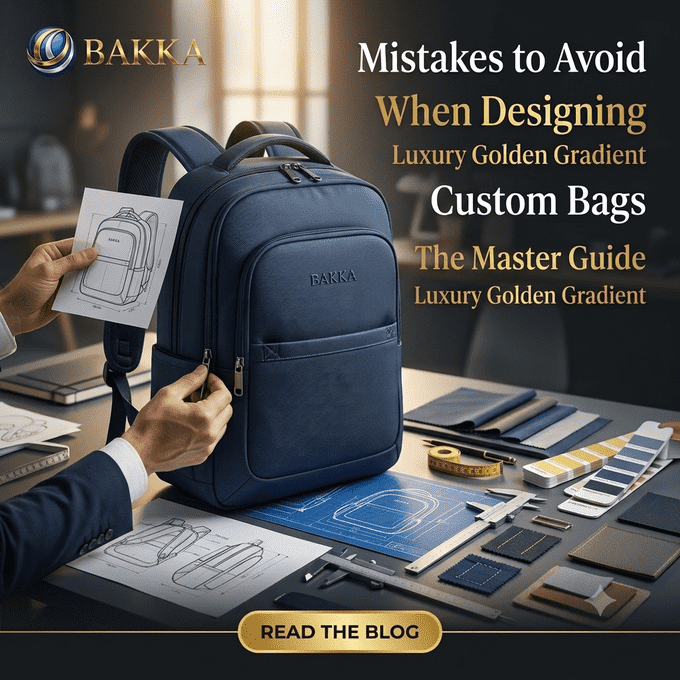
🎯 Mistakes to Avoid When Designing Custom Bags: The BAKKA Bags Master Guide
By BAKKA Bags | India's Bag Authority
Designed for Indian brands, corporate buyers, and manufacturers who want bags that actually work.
That Bengaluru IT company ordered 500 premium laptop backpacks for corporate gifting. The brief looked perfect: navy blue, padded, ₹900 per piece. Three months later? The shoulder straps caused discomfort after 15 minutes of Metro commuting. The laptop compartment was too narrow for standard 15.6-inch devices. The screen-printed logo looked cracked because it was placed directly over a seam.
Result: ₹4.5 lakh wasted.
This happens every month across India — in Gurugram offices, Mumbai gifting agencies, and Chennai procurement departments. The root cause is almost never a bad manufacturer. It's almost always a flawed design brief.
At BAKKA Bags, we've worked with hundreds of brands to create bags that perform in real Indian conditions — monsoon rains, summer heat, crowded local trains, and daily 8-hour usage. Here's how to avoid the 12 biggest design mistakes.
Mistake 1: 👤 Designing for Looks, Not the End User
The most fundamental mistake: creating a bag that looks good but doesn't serve its user.
Before any design decision, answer:
-
Who's the primary user? (College student, corporate professional, delivery executive)
-
What will they carry? (Laptop + charger, documents + lunch, groceries, supplies)
-
Where will they use it? (Office, trains, warehouses, outdoor heat)
-
How many hours daily? (1 hour or 8 hours?)
-
What's the use case? (Corporate gifting, daily wear, retail)
Indian Reality Check: A corporate bag for Delhi Metro commuters carries 15.6-inch laptops, chargers, tiffin boxes, water bottles, power banks, and documents. Design for this — not for a Pinterest image.
Mistake 2: 🧵 Choosing the Wrong Material
This is the most technically complex decision — and most commonly made on appearance alone.
Common Indian mistakes:
-
Using 300D–420D polyester for bags carrying 5–8 kg regularly ❌
-
Choosing cotton canvas without accounting for monsoon moisture absorption ❌
-
Selecting PU leather that cracks in Indian summer heat ❌
-
Picking fabrics incompatible with printing methods ❌
Material Selection Guide:
|
Bag Type |
Recommended Material |
Why |
|
Laptop & Corporate Bags |
1,680D polyester, 600D nylon, RPET |
Durable for 5–8 kg daily loads |
|
Travel & Trolley Bags |
Ballistic nylon, coated polyester |
Weather-resistant |
|
Tote & Grocery Bags |
Canvas, jute, non-woven PP |
Cost-effective for retail |
|
Premium Gifting |
PU leather, vegan leather, microfiber |
Brand prestige |
|
School Bags |
600D–900D polyester |
Withstands 6–7 kg books + monsoon |
BAKKA Rule: Never approve fabric from photos. Request physical swatches, test them, splash water on them, stretch them.
Mistake 3: 🌀 Overcomplicating the Design
More pockets ≠ better bag. More features = higher costs, longer timelines, more defects.
Every additional zipper, panel, embellishment, or trim:
-
📈 Increases per-unit cost
-
⏳ Extends lead times
-
📉 Creates more failure points
-
🔁 Makes quality control harder
The BAKKA Principle: Design for function first. Every element must serve a purpose. If it doesn't improve user experience or durability, remove it.
Mistake 4: 📐 Poor Compartment Planning
A beautiful bag that's useless inside disappoints by week one.
Common failures:
-
Laptop sleeves too small for 15.6-inch devices
-
Water bottle pockets too shallow for 1-litre bottles
-
No quick-access phone/card pocket
-
All pockets same depth (everything piles up)
Indian Daily Carry Reality: 15.6-inch laptop, charger brick, cable, A4 documents, tiffin box, water bottle, phone, power bank. Design around this.
Mistake 5: ⚖️ Ignoring Ergonomics
A bag that causes discomfort gets abandoned — brand reputation walks away with it.
Comfort-Killers:
-
Straps narrower than 3 cm (cut shoulders under load)
-
Flat, unpadded backs (trap heat in Indian humidity)
-
No chest strap on heavy backpacks
Comfort-Builders:
-
4–5 cm padded shoulder straps for bags over 3 kg
-
Air mesh back panels (essential in ₹50°C+ summer)
-
Padded lumbar support
-
Adjustable sternum strap for weight distribution
An IT professional in Bengaluru carries their bag 45–90 minutes daily on crowded trains. Comfort isn't a luxury — it's the baseline.
Mistake 6: 🪡 Weak Stitching & Construction
Premium fabric + cheap construction = product failure.
Construction Killers:
-
Single stitching at strap attachment points (first to tear)
-
Seam allowance under 8 mm (no room for stitching to hold)
-
No binding tape on internal edges
Construction Standards (Non-negotiable):
-
Box-X stitching at all strap attachments
-
Double stitching on primary seams
-
Bartack reinforcement at zippers and pocket corners
-
Binding tape on all internal edges
BAKKA applies Box-X reinforcement everywhere — not as an upgrade, as a baseline.
Mistake 7: 🔧 Using Low-Quality Hardware
Zippers, buckles, D-rings, sliders — the user touches these every day. Cheap hardware is remembered forever.
Hardware Disasters:
-
Jamming, splitting zippers (weeks, not years)
-
Rust-prone metal (coastal cities: Mumbai, Chennai, Kochi)
-
Weak plastic buckles that snap under load
-
Mismatched finishes (gold zipper + silver D-ring = cheap look)
Test Protocol:
-
Open/close zippers 50 times (must glide smoothly)
-
Clip/unclip buckles 10 times under load (zero deformation)
-
Corrosion resistance check (especially coastal India)
One broken zipper on a ₹1,500 gifting bag undoes your brand credibility.
Mistake 8: 🖨️ Getting Branding Placement Wrong
Your logo is working 24/7 as a mobile advertisement. Placed poorly, it fails — or worse, looks cheap.
Critical Errors:
-
Placing logo over seams (appears cracked/warped)
-
Low-contrast colours (navy logo on dark blue = invisible)
-
Oversized logos (aggressive, unprofessional)
-
Logo hidden behind straps during normal use
|
Bag Type |
Best Branding Method |
|
Corporate Laptop Bag |
Embroidery or Debossing |
|
Promotional Tote |
Screen Printing |
|
Premium Gifting |
Embossing or Metal Plate |
|
Sports/Gym Bag |
PVC Patch or Screen Printing |
Mistake 9: 📁 Wrong Artwork Files
A bad file produces bad output. Always.
-
❌ JPEG/PNG for bulk printing
-
✅ Vector files (.AI, .EPS, vector PDF)
-
✅ 300 DPI+ minimum for raster
-
✅ Pantone (PMS) colour codes specified
Non-negotiable: Vector files scale infinitely without quality loss. Raster files don't. Period.
Mistake 10: 🏭 Designing Without Manufacturing Feasibility
Involve your manufacturer during design — not after.
Common Impossibilities:
-
Curved panels (too complex, expensive)
-
Impossible stitching angles
-
Custom hardware requiring new tooling
-
Print areas on stretching panels
BAKKA Solution: We conduct a Design Feasibility Review before sampling. This single conversation saves 2–4 weeks and significant cost revisions later.
Mistake 11: 🚫 Skipping Prototype & Sample Stage
"The mockup looks fine" = dangerous words.
Digital renders tell you nothing about physical reality.
Required Sampling Path:
-
Prototype Sample (concept validation)
-
Pre-Production Sample (final approval)
-
Production Sample (consistency check from first 10–20% of run)
Test Every Sample:
-
Load with full intended weight
-
Wear for 30 minutes (comfort test)
-
Open/close every zipper 20 times
-
Compare branding to artwork
-
Inspect all stress points
Mistake 12: 📦 Ignoring Packaging & Shipping
Design doesn't end at the bag.
Logistics Considerations:
-
Can the bag be flat-packed for carton space efficiency?
-
Can cartons stack safely without crushing bags?
-
Are delicate trims protected during multi-leg transit (factory → warehouse → courier → customer)?
-
Does packaging reflect brand quality for gifting?
In India, bags travel through multiple freight legs. Bad packaging = damaged products even if production was perfect.
The Cost of Mistakes
Consider a ₹9 lakh order (1,000 bags @ ₹900 each):
-
Wrong material → 20% premature wear = ₹1.8 lakh replacement cost
-
Weak stitching → 10% torn straps = ₹90,000 + client relationship damage
-
Logo over seam → All 1,000 bags flawed = Total rejection
-
Skipped prototype → Laptop compartment 1.5 cm too narrow = 1,000 unusable bags
The cost of getting it right — proper briefing, sampling, testing — is a fraction of getting it wrong.
✅ Design Checklist: Before You Brief
-
Who is the end user and their daily use context?
-
What load requirements? (Light/Medium/Heavy)
-
Appropriate fabric and GSM?
-
Material compatible with branding?
-
All design elements mapped to actual user needs?
-
Design reviewed for production feasibility?
-
Logo in vector format with Pantone reference?
-
Physical prototype ordered and tested?
-
Packaging logistics planned?
-
Pre-Production Sample approved before bulk production?
The Bottom Line
A great custom bag isn't a good idea. It's a good process — one that puts users first, respects manufacturing reality, and demands physical testing before bulk commitment.
Every mistake here is avoidable. Every one has been made by smart brands who simply didn't know what to look for.
Design thoughtfully. Sample thoroughly. Manufacture confidently.
At BAKKA Bags, we bring this discipline to every order — whether it's 100 bags or 100,000. Our job isn't just to manufacture bags. It's to ensure your bag works for your users, your brand, and your business.
BAKKA Bags | Crafted with Purpose. Built to Last. 🎒✨
Let's Talk Bags
Fill the form and we will connect within 24 hours