Bag Compliance Checklist: Labelling, Export Rules & Global Standards
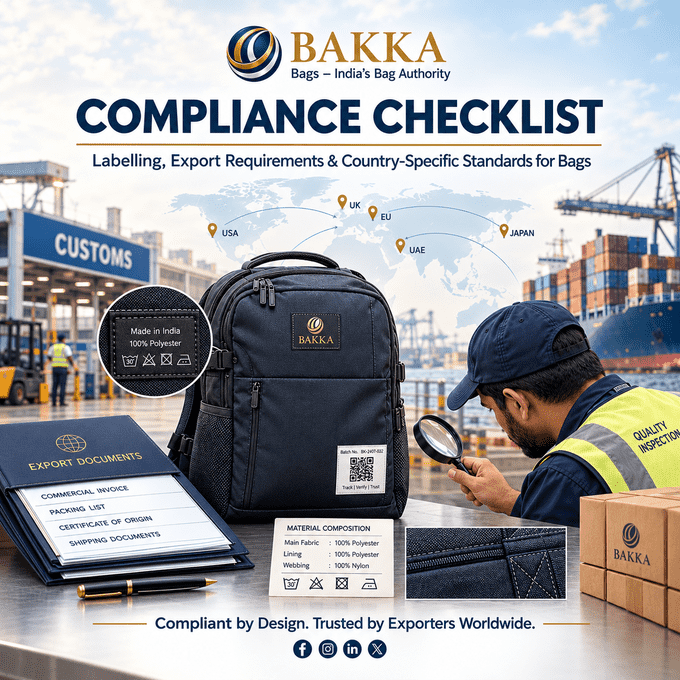
🏷️ Compliance Checklist: Labelling, Export Requirements & Country-Specific Standards for Bags
You're standing at customs in Rotterdam with a shipment of 10,000 bags from India. The inspector points to your label and says: "This does not comply." ❌
Your entire shipment is detained. Your customer waits. Your reputation suffers. Your profit margin evaporates.
This scenario plays out regularly for Indian bag manufacturers who treat compliance as an afterthought. At BAKKA Bags, we view compliance differently—not as a cost, but as a competitive advantage. 🚀
🎯 The Golden Rule: Your Label Is a Legal Document
Every word on your label is a legal representation. Consider these:
-
Label says "100% Leather" → Material is bonded leather → Fraud ⚖️
-
Label claims "Made in India" → Assembly happened elsewhere → Trade law violation
-
Label claims "Eco-Friendly" → No certification number → Greenwashing
-
Label shows "OEKO-TEX Certified" → You can't verify it → False advertising
Cardinal Rule: If you can't verify it with a third-party certificate, don't put it on the label.
📋 Universal Labeling Requirements for Every Bag
Every bag, regardless of destination, must carry these mandatory elements:
-
Country of Origin: "Made in India" (stitched, embossed, or heat-pressed—never stick-on) 🇮🇳
-
Fiber Composition: Exact percentages by weight (e.g., "65% recycled polyester, 35% organic cotton")
-
Care Instructions: Wash, dry, storage instructions in destination language + ISO symbols
-
Manufacturer/Importer Details: Full name, address, email, phone (no PO boxes)
-
Size/Dimensions: Height, width, depth in centimetres and inches
-
Batch/Lot Number: Traceability code for quality control and recalls
-
Certifications: Certificate name + number (e.g., "GOTS cert no. XXXXX")
BAKKA's Label Standard: Every bag carries a permanently stitched, double-layered label including country of origin, full material breakdown, care instructions in English + Hindi + regional languages, QR-coded batch numbers, and all certification logos with numbers. ✅
🇮🇳 Domestic Compliance: The Indian Market
Bureau of Indian Standards (BIS)
While BIS doesn't mandate standards for all bags, certain categories are regulated:
-
School Bags (IS 15520:2005): Weight limit ≤ 10% of child's body weight; strap strength ≥ 15 kgf; reflective material mandatory; non-toxic materials only
-
Leather Bags (IS 5800): Chromium content < 3 mg/L; tensile strength ≥ 25 MPa; colorfastness to light, water, and rubbing
-
Textile Bags (IS 1963:1981): Fabric weight 150–300 GSM; tear strength ≥ 3 kgf; shrinkage limit ≤ 5%
-
Children's Products (IS 9873): Small parts testing; no sharp edges; chemical migration limits
Legal Metrology Rules 2011
Every bag sold in India must display:
-
MRP (Maximum Retail Price) including all taxes
-
Net Quantity (weight or dimensions clearly stated in grams/kilograms)
-
Manufacturer Details (full name and address)
-
Month/Year of Manufacture (batch-coded preferred)
-
Customer Care (phone and email)
Extended Producer Responsibility (EPR) for Plastic
If your bags contain plastic components, you must:
-
Register with authorized agency (CPCB/state pollution control board)
-
Maintain plastic packaging records
-
Submit annual reports
-
Collect and recycle plastic packaging
Penalty: Fines up to ₹1,00,000 + possible business suspension ⚠️
🌍 Export Compliance: Key International Markets
🇪🇺 European Union (Highest Standards)
-
REACH Compliance: No restricted substances (lead, cadmium, nickel, azo dyes, phthalates). Penalty: Ban + €50,000 fines per product line
-
Labeling: Multiple languages (English + local); fiber composition as percentages; ISO care symbols
-
OEKO-TEX® Testing: Almost universal requirement—missing = automatic rejection
🇺🇸 United States (Strict on Safety)
-
CPSIA (Children's Products): Lead < 100 ppm, phthalates < 0.1%; third-party testing mandatory. Penalty: Fines up to ₹1.25 crore + criminal liability
-
California Prop 65: Warning label required if bag contains listed chemicals. Penalty: Lawsuits; settlements ₹50,000–₹75 lakhs per violation
-
FTC Fiber Act: Accurate fiber names. "Made in India" must be conspicuous and permanent.
🇬🇧 United Kingdom (Post-Brexit)
-
UK REACH: Separate registration required; deadline 2027
-
Labeling: English-only (not multilingual like EU)
-
UKCA Marking: Required for smart bags (GB) or CE/UKNI (Northern Ireland)
🇦🇪 United Arab Emirates
-
ECAS (Emirates Conformity Assessment): Mandatory for leather bags
-
Labeling: Bilingual—Arabic AND English for fiber composition, origin, care instructions
-
Halal Certification: Increasingly required for leather sourcing
🗾 Japan (Unique Chemical Restrictions)
-
Quality Labeling Law: Japanese language mandatory; fiber composition, care instructions, country of origin required
-
CSCL (Chemical Substance Control Law): Restrictions on specific chemical substances (similar to REACH)
-
JIS Standards: Voluntary but recommended for quality management (JIS Q 9100)
🏆 Critical Certifications for Export Success
|
Certification |
Covers |
Where It Matters |
Why Buyers Care |
|
OEKO-TEX® 100 |
Harmful substances in textiles |
EU, USA, UK, Japan, UAE |
Almost universal requirement |
|
GOTS |
Organic cotton sourcing + processing |
EU, USA, Australia |
Essential for organic claims |
|
GRS |
Recycled content + chain of custody |
EU, USA, UK |
Required for recycled claims |
|
LWG (Gold/Silver) |
Responsible leather tanning |
EU, USA, UAE |
Expected for premium exports |
|
BSCI |
Factory social compliance |
EU retailers (Aldi, Tchibo) |
Mandatory for major buyers |
|
FSC |
Packaging and paper sourcing |
EU, USA, UK |
Expected for sustainability positioning |
📦 Universal Export Documents Required
Every shipment from India must include:
-
IEC (Importer Exporter Code): Issued by DGFT—mandatory
-
Commercial Invoice: Detailed transaction record with HS code, unit price, total value
-
Packing List: Itemized contents, weights, carton dimensions
-
Bill of Lading/Airway Bill: Proof of shipment
-
Certificate of Origin (COO): For preferential tariffs
-
Shipping Bill: Filed with customs for export clearance
-
HS Code: Verified with licensed customs broker
Red Flag: Incorrect HS code = customs fines, seizure, and fraud investigation. 🚩
⚠️ Common Compliance Pitfalls (How to Avoid Them)
-
Stick-on Labels Instead of Permanent: Labels fall off during shipping → Use embossed, heat-pressed, or stitched labels only
-
Labels in English Only for EU/UAE: Import rejection → Translate care + composition into destination languages
-
False "Eco-Friendly" Claim Without Certification: Greenwashing lawsuits → Never claim without certification number
-
Misclassified HS Code: Customs detention → Use experienced customs broker; verify before every shipment
-
Missing Batch Tracking: Unable to manage recalls → Implement QR-coded batch tracking system
-
No NABL-Accredited Test Reports: Customs rejection → Use NABL labs for Indian testing
🤝 The BAKKA Promise: Compliance Built In, Not Bolted On
At BAKKA Bags, compliance isn't an afterthought. We engineer it into every stage:
-
✅ Regulatory Affairs Team monitoring 15+ countries' regulations
-
✅ Label templates updated within 30 days of regulation changes
-
✅ Certification Library with every batch's certificates
-
✅ Pre-shipment guarantee: If customs rejects due to BAKKA error, we cover re-shipment
-
✅ Compliance support for all retail and B2B partners
When you partner with BAKKA, you're not just buying bags. You're buying compliance confidence. 🌟
BAKKA Bags – Compliant by Design. Trusted by Exporters Worldwide. 🌍✨
Let's Talk Bags
Fill the form and we will connect within 24 hours