Bag Import Guide for India: Incoterms, Duties, HS Codes & Customs
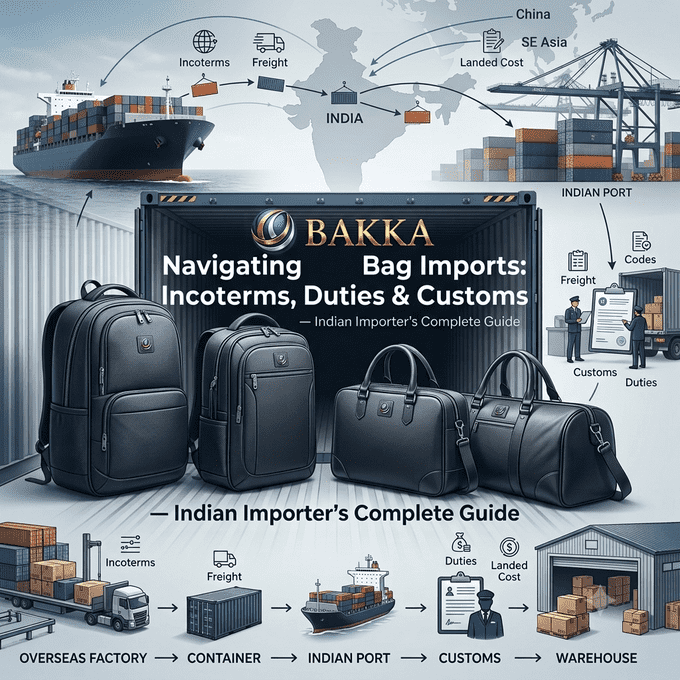
🌏 Navigating Bag Imports: Incoterms, Duties & Customs — Indian Importer's Complete Guide
By BAKKA Bags | India's Bag Authority
You've found the perfect bag. Samples look flawless. Price is competitive. Order placed.
Then it hits: freight quotes in arcane terms, customs duties you never budgeted for, hidden port charges in rupees, and HS codes you've never heard of.
For many Indian businesses — first-time importers and seasoned buyers alike — the journey from factory floor to warehouse shelf is where margins disappear quietly. At BAKKA Bags, we've navigated this import labyrinth extensively, and today we're sharing our insider knowledge so you don't learn it the expensive way.
This is your complete guide to importing bags: Incoterms decoded, duties explained, customs clearance demystified, and the hidden costs that catch importers off guard.
🚨 Why Bag Importing Costs More Than You Think
Importing bags from Vietnam, Bangladesh, China, or even domestic Indian manufacturers can reduce sourcing costs significantly. But the gap between factory price and landed cost is massive.
Freight terms, GST/customs duties, broker fees, and port charges can add ₹3,000–₹9,000 per carton to your unit cost if not planned carefully. That's a 15–40% increase over factory price — before your profit margin.
The businesses winning in imports are those who master the full cost picture — not just the product cost.
📋 The Four Pillars of Successful Bag Importing
Before diving deep, here's the framework every Indian bag importer must understand:
-
Incoterms — Who is responsible for what, and when
-
Freight Methods — How your bags move across borders
-
Import Duties & HS Codes — What you owe Indian customs
-
Customs Clearance & Documentation — Legal entry into India
Master these four, and you control your supply chain. Miss one, and profitability suffers.
1️⃣ Incoterms — The Rules Governing International Trade
Incoterms® (published by the International Chamber of Commerce) are globally standardised rules defining exactly where the seller's responsibility ends and the buyer's begins. Always specify Incoterms® 2020 in your contracts.
🏭 EXW (Ex Works)
Supplier's responsibility ends at the factory gate.
You handle: Export documentation, freight booking, insurance, customs clearance, duties, and inland transport.
Verdict: ⚠️ Avoid unless you have established logistics contacts in the origin country. Navigating foreign export procedures is a bureaucratic minefield.
🚢 FOB (Free On Board) — The Industry Standard
Supplier delivers goods onto the ship at the named port. Risk and cost transfer to you once goods are onboard.
Supplier handles: Production, packaging, local inland transport to port, export clearance, and loading.
You handle: International freight, insurance, import customs, duties, and final delivery.
Verdict: ✅ Recommended for most Indian importers. You control freight forwarder selection, maintain cargo visibility, and negotiate competitive shipping rates.
📦 CIF (Cost, Insurance & Freight)
Supplier arranges and pays for freight and basic insurance to your destination port.
Supplier handles: Production, export clearance, international freight, and basic insurance.
You handle: Import clearance, duties, final delivery, and any insurance shortfall.
Verdict: ⚠️ Convenient but expensive. Suppliers mark up freight costs, and the insurance included is often minimal coverage. You lose scheduling control.
2️⃣ Freight Methods — Moving Bags Into India
Bags are lightweight but high-volume — meaning dimensional weight (space occupied) often matters more than actual weight.
✈️ Air Freight
-
Cost: ₹400–₹600 per kg
-
Transit time: 3–10 days
-
Best for: Urgent samples or high-value specialty bags
-
Reality: Uneconomical for bulk bag orders
🚢 Sea Freight (Most Cost-Effective)
LCL (Less Than Container Load):
-
Shares container space with other shipments
-
Best for trial orders, smaller volumes
-
Higher per-unit cost
-
Higher handling risk
FCL (Full Container Load):
-
You book entire 20ft or 40ft container
-
Best for large, consistent orders
-
Lower per-unit cost (₹150–₹300 per carton)
-
Lower damage risk
-
Faster loading/unloading
Typical sea freight timelines to Indian ports:
-
Vietnam/Bangladesh → Mumbai: 10–15 days
-
China → Mumbai: 18–25 days
-
China → Chennai: 20–28 days
BAKKA Insight: For structured bags, hardshell luggage, or shaped products — insist on palletisation, not floor-loading. Floor-loaded containers crush frames, deform shapes, and damage finishes.
3️⃣ Import Duties & HS Codes — What You Owe Indian Customs
🔢 HS Code: Your Product's Identity Number
Every bag is classified under the Harmonized System (HS) Code — a global standard that determines:
-
Import duty rate
-
GST obligations
-
Trade restrictions or anti-dumping duties
-
Compliance requirements
For bags, the primary classification is Chapter 42 (Articles of leather, travel goods, handbags):
|
Bag Type |
HS Code |
|
Backpacks, sports/travel bags (textile) |
4202.92 |
|
Handbags (leather/synthetic) |
4202.21 / 4202.91 |
|
Suitcases, luggage |
4202 series |
|
Laptop bags, briefcases |
4202.12 |
⚠️ Critical: Wrong HS code = customs delays, penalties, seizure, and legal liability. Always verify with a licensed customs broker before importing.
💰 Duty Rates & GST in India
|
Bag Type |
Basic Duty |
Applicable GST |
Approx. Total Cost |
|
Textile/Polyester bags |
10–15% |
18% |
28–33% above FOB |
|
Leather/PU bags |
15–20% |
18% |
33–38% above FOB |
|
Specialty/Branded bags |
20–25% |
18% |
38–43% above FOB |
Example: ₹100 FOB backpack → ₹128–₹133 landed cost (before transport & broker fees).
4️⃣ Customs Clearance — Getting Bags Into India
📋 Essential Documents:
-
Commercial Invoice
-
Packing List
-
Bill of Lading (sea) or Air Waybill
-
Certificate of Origin
-
GST Compliance documents
-
Insurance Certificate
-
HS Code Details
🚨 Common Mistakes Indian Importers Make:
-
Misdeclaring materials (polyester vs. PU leather)
-
Missing "Made in [Country]" labelling
-
Undervaluing shipments to reduce duties (customs fraud)
-
Incomplete origin documentation
💼 Hire a Licensed Customs Broker
Broker fees: ₹5,000–₹15,000 per shipment — worth every rupee. They ensure:
-
Correct HS classification
-
Accurate duty calculation
-
Compliance with labelling requirements
-
Smooth port clearance
5️⃣ Real-World Landed Cost Example (Indian Importer)
1,000 textile backpacks, FOB Vietnam to Mumbai:
|
Component |
Amount (₹) |
|
Product (1,000 × ₹800) |
₹8,00,000 |
|
Sea Freight (LCL) |
₹25,000 |
|
Cargo Insurance |
₹8,000 |
|
Import Duty (12% of ₹8,00,000) |
₹96,000 |
|
GST (18% on ₹8,00,000) |
₹1,44,000 |
|
Customs Broker Fee |
₹10,000 |
|
Port Handling & Delivery |
₹20,000 |
|
Total Landed Cost |
₹10,03,000 |
|
Cost Per Unit |
₹1,003 |
|
vs. FOB |
₹25.375% increase |
6️⃣ BAKKA's Import Strategy by Experience Level
|
Profile |
Recommended Incoterm |
Freight Mode |
Key Priority |
|
First-Time Importer |
CIF |
LCL Sea |
Simplicity & learning |
|
Growing Importer |
FOB |
LCL/FCL Sea |
Cost control |
|
Established Importer |
FOB |
FCL Sea |
Volume discounts |
|
Expert/High-Volume |
EXW or FOB |
FCL + Air for urgents |
Margin optimisation |
✅ BAKKA's Pre-Shipment Checklist
-
✓ Incoterms confirmed (Incoterms® 2020)
-
✓ HS code verified with customs broker
-
✓ Landed cost calculated (all duties & fees)
-
✓ Country-of-origin labelling confirmed
-
✓ All import documents prepared
-
✓ GST Compliance confirmed
-
✓ Pre-shipment inspection booked (for bulk orders)
-
✓ Insurance adequate for cargo value
-
✓ Freight forwarder & broker engaged before shipment
🎯 Final Word from BAKKA Bags
Importing bags is a margin management discipline.
Businesses with sustainable, profitable import operations invest in understanding every cost link — from Incoterms to duty calculations to final warehouse delivery. At BAKKA Bags, we've built our entire sourcing operation on this foundation. We calculate every cost, verify every classification, and partner with logistics professionals who know bags.
Let's Talk Bags
Fill the form and we will connect within 24 hours