Bag Materials Side-by-Side: What's the Difference?
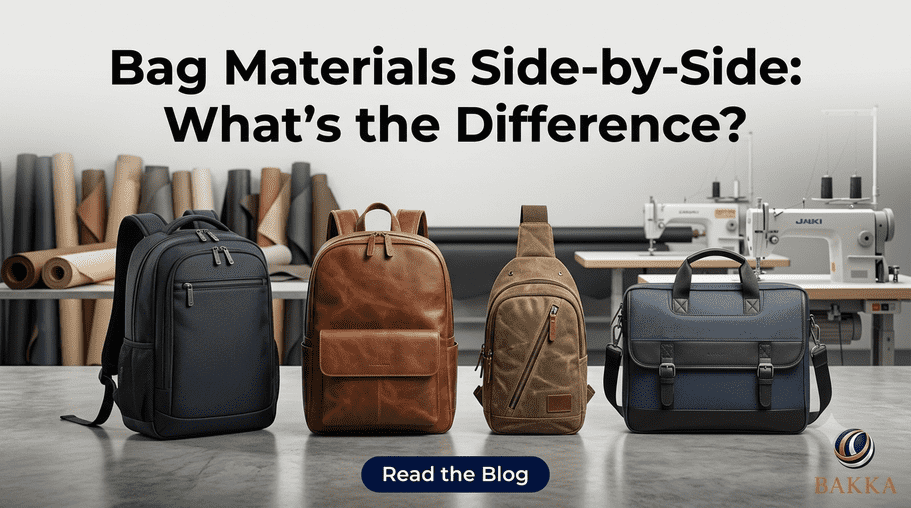
By BAKKA Bags | The Material Intelligence Series — Volume III
You're standing in front of two bags. Same style. Same price. Same size. One is canvas. One is nylon. Which one do you buy?
Most people guess. They go by how the bag looks in the photo, how it feels in hand for thirty seconds in the store, or which word sounds most premium. Three months later, one person's bag is holding up perfectly. The other person's is already pilling at the bottom corners, staining from a coffee spill, or refusing to dry after a sudden rain shower.
The difference wasn't luck. It was material.
At BAKKA Bags, we've spent years working with materials at production level — specifying them, testing them, watching them perform in real use, and understanding exactly where each one excels and where it fails. This guide is a distillation of that experience.
We're not just telling you what each material is. We're telling you how they compare against each other — head-to-head, dimension by dimension — so you can make the right call every single time.
🎯 The Eight Dimensions That Actually Matter
Before we compare anything, let's agree on what we're comparing. Material choice affects eight specific dimensions that directly impact your experience of owning and using a bag:
-
Durability — How long does it genuinely last under real use conditions?
-
Weight — How much does the material itself add to the overall carry?
-
Water & Weather Resistance — How does it behave when it rains?
-
Breathability — Does it trap heat or allow air circulation?
-
Ageing Behaviour — Does it improve, hold steady, or deteriorate over time?
-
Maintenance Effort — How much work does it take to keep it looking good?
-
Sustainability Profile — What's the honest environmental story?
-
Brand & Style Positioning — What does the material communicate about the person or brand using it?
Every comparison in this guide is structured around these eight dimensions. Not because we want to overcomplicate things — but because every one of them will matter to you at some point during the life of a bag.
🧭 The Materials We're Comparing
This guide covers the eight most important bag materials in the market today, organised into three natural groups:
Natural & Heritage Materials:
-
🐄 Genuine / Full-Grain Leather
-
🌿 Canvas (Cotton)
Synthetic Performance Fabrics:
-
⚙️ Nylon
-
🔧 Polyester
-
🛡️ Cordura® Nylon
Vegan & Alternative Materials:
-
🧴 PU Leather (Polyurethane)
-
♻️ rPET (Recycled Polyester)
-
🌱 Jute / Hemp
📊 The Master Comparison Table
Your at-a-glance reference before we dive deep:
|
Material |
Durability |
Weight |
Water Resistance |
Breathability |
Ageing |
Maintenance |
Eco Profile |
Brand Positioning |
|
Full-Grain Leather |
★★★★★ |
Heavy |
Low (untreated) |
★★★★☆ |
Improves |
High effort |
Animal-derived |
Luxury / Heritage |
|
Canvas |
★★★★☆ |
Medium–Heavy |
Low (untreated) |
★★★★★ |
Improves |
Moderate |
Natural / Biodegradable |
Lifestyle / Eco |
|
Nylon |
★★★★★ |
Very Light |
★★★★☆ |
★★☆☆☆ |
Holds well |
Very Easy |
Petroleum |
Technical / Premium |
|
Polyester |
★★★☆☆ |
Light |
★★★☆☆ |
★★☆☆☆ |
Pills over time |
Very Easy |
Petroleum |
Functional / Everyday |
|
Cordura® |
★★★★★+ |
Medium |
★★★★★ |
★★★☆☆ |
Excellent |
Easy |
Petroleum |
Tactical / Premium |
|
PU Leather |
★★★☆☆ |
Light |
★★★☆☆ |
★☆☆☆☆ |
Peels/degrades |
Very Easy |
Petroleum |
Fashion / Accessible |
|
rPET |
★★★☆☆ |
Light |
★★★☆☆ |
★★☆☆☆ |
Pills over time |
Very Easy |
Recycled Plastic |
Sustainable / Functional |
|
Jute / Hemp |
★★★☆☆ |
Medium |
★☆☆☆☆ |
★★★★★ |
Holds character |
Moderate |
Excellent |
Eco / Natural |
🐄 MATCHUP 1: Full-Grain Leather vs. Canvas
The original heavyweights. Both natural. Both built to last. But dramatically different in how they perform and what they communicate.
Durability
Leather wins — but canvas closes the gap at heavier weights.
Full-grain leather's fibre structure is extraordinarily dense. The intact grain provides tensile strength that no woven fabric can quite match at equivalent weight. A quality full-grain leather bag, properly maintained, realistically lasts 20–30 years. Heritage leather goods from the 1970s are still in daily service. That level of longevity is the product of the material itself.
Heavy canvas — 12oz and above — is genuinely tough. It resists tearing, abrasion, and puncture well. But it doesn't approach leather's lifespan under equivalent daily stress. The honest comparison: a full-grain leather bag lasts twice as long as a comparable canvas bag under heavy daily use.
BAKKA Bags Verdict: Leather for longevity investment. Heavy canvas for durable everyday performance at a lower price point.
Ageing Behaviour
Canvas wins on accessibility. Leather wins on the romance of ageing.
This is where the comparison gets interesting — because both materials improve with age, which is genuinely rare in any product category.
Full-grain leather develops a patina — a deepening, richening of the surface colour and character that comes from the oils of regular handling, light exposure, and the gentle friction of daily use. A well-used leather bag at five years is more beautiful than a new one. At ten years, it's irreplaceable. This is a material property unique to genuine leather; no synthetic can replicate it.
Heavy canvas softens, conforms to the wearer's body, and develops a character that feels lived-in in the best possible sense. Waxed canvas develops surface marks and scuffs that add to its rugged story rather than detracting from it. But the transformation is more functional than aesthetic — it softens and relaxes rather than deepening in visual richness.
BAKKA Bags Verdict: Both improve with age. Leather's improvement is more dramatic and visually distinctive. Canvas's improvement is more about comfort and character.
Water Resistance
Neither wins untreated. Canvas wins in the treated category.
Raw leather absorbs water — and water damage to leather is serious. Prolonged moisture causes staining, structural weakening, and if dried too quickly, cracking. Conditioned and properly treated leather handles brief exposure well, but a heavy rain soaking is a genuine problem.
Untreated cotton canvas is similarly absorbent. However — and this is important — waxed canvas dramatically changes the equation. A properly waxed canvas bag is genuinely water-repellent, breathes unlike any coated synthetic, and can have its water repellency restored indefinitely by re-waxing. This gives waxed canvas a practical rain-performance edge over untreated leather.
BAKKA Bags Verdict: Treat both. Waxed canvas + treated leather both perform acceptably in rain. If water performance is the primary requirement, neither is the optimal choice — that's nylon's territory.
Sustainability
Canvas wins — clearly.
Full-grain leather has a complex environmental and ethical footprint. The tanning process — particularly chrome tanning — is resource-intensive and produces significant chemical waste. Animal welfare concerns are real and increasingly relevant to brand positioning. Leather is durable and biodegradable in the long term, but the production process is difficult to defend in a sustainability narrative.
Organic cotton canvas is genuinely biodegradable and compostable at end of life. Organic cultivation avoids pesticides and the GOTS certification verifies the entire supply chain. For brands with genuine sustainability commitments, canvas is the natural material of choice.
BAKKA Bags Verdict: Canvas wins on sustainability. Leather wins on longevity — but longevity is sustainability's best argument for leather.
Brand Positioning
Different leagues — deliberately.
Leather says: investment, seriousness, permanence, luxury, professional authority. It is the material of boardrooms, briefcases, and heirlooms.
Canvas says: craft, character, outdoor credibility, eco-consciousness, relaxed confidence. It is the material of artists, travellers, and farmers' markets.
Neither is better. They speak to entirely different audiences. The worst mistake a brand can make is choosing one when they mean to communicate the other.
BAKKA Bags Verdict: Know your audience. Leather for professional and luxury positioning. Canvas for lifestyle, heritage, and eco positioning.
⚙️ MATCHUP 2: Nylon vs. Polyester
Two synthetic cousins. Superficially similar. Meaningfully different. This is the comparison most buyers get wrong.
The Fundamental Difference Most Buyers Miss
Nylon and polyester look similar. They're both lightweight synthetic fabrics. They're both water-resistant. They're both used in backpacks and travel bags. And at a glance, they can be hard to distinguish.
But here's what most product descriptions never tell you: nylon outperforms polyester across nearly every meaningful quality metric. The difference is not marginal. At equivalent Denier ratings, nylon is:
-
More abrasion-resistant — by a measured factor of 2–3×
-
Stronger per unit weight
-
More supple and packable
-
More premium in hand-feel and drape
-
More resistant to tearing at stress points
The reason most bags are made from polyester rather than nylon is simple: polyester costs less. That's it. Not because polyester performs better. Because it's cheaper to produce.
Durability Head-to-Head
Nylon wins — it's not close at equivalent specifications.
The easiest way to illustrate this: the bottom corners of a bag are its highest-wear zone — that's where bags are set down on hard floors hundreds of times per year. In a direct abrasion test between 600D nylon and 600D polyester, nylon will outlast polyester by a significant margin before showing meaningful wear.
Polyester pills — the friction of regular use creates small fibre balls on the fabric surface. These don't cause structural failure, but they make the bag look progressively more worn. Nylon resists pilling significantly better.
BAKKA Bags Verdict: For any bag intended to last more than two years under regular use, specify nylon over polyester of the same Denier.
Weight
Nylon wins — slightly but meaningfully.
At equivalent fabric weights, nylon achieves higher strength — meaning you can use a lighter Denier nylon to achieve the same durability as a heavier Denier polyester. The practical result: a nylon bag is typically lighter than an equivalent-durability polyester bag.
Water & Weather Resistance
Both perform well. Nylon has a structural edge.
Tightly woven nylon — particularly with a DWR (Durable Water Repellent) treatment — is naturally water-resistant at the fibre level. Water beads and rolls off more readily from nylon due to the fibre's smoother surface.
Polyester requires a PU coating or DWR treatment to achieve comparable water resistance, and that coating degrades with use and washing. Coated polyester starts at a similar water resistance level but drops off faster over time.
BAKKA Bags Verdict: Both are adequate for everyday weather. Nylon holds its water resistance longer. For genuinely wet conditions, specify ripstop nylon with DWR rather than standard coated polyester.
Cost
Polyester wins — and this is where most buying decisions end.
Polyester costs approximately 30–60% less per metre than equivalent nylon. For volume promotional bags or budget-tier everyday carry, this cost difference is commercially significant.
But the calculation changes when you factor in lifespan. A nylon bag that lasts 5 years costs less per year of use than a polyester bag that lasts 2 years — even if the polyester bag's purchase price was lower.
BAKKA Bags Verdict: Polyester for cost-sensitive volume applications. Nylon for every application where quality and longevity are the primary brief.
The Denier Specification Table — The Number That Changes Everything
Both materials are specified by Denier (D) — a measure of fibre density. Here's how to read it for both:
|
Denier Range |
Polyester Performance |
Nylon Performance |
|
150D–210D |
Very light; limited durability; packable stuff sacks |
Excellent lightweight; strong packable bags |
|
300D–420D |
Light everyday bags; moderate durability |
Very capable everyday carry; good durability |
|
600D–900D |
Good functional backpacks; standard quality |
Excellent performance; premium everyday bags |
|
1000D–1680D |
Heavy-duty; maximum polyester durability |
Ballistic nylon; extraordinary durability |
💡 BAKKA Bags Insider Note: When a manufacturer's spec sheet says "polyester" without a Denier number, that is an incomplete specification. Always request and confirm the Denier. A "polyester backpack" at 210D is a completely different product from a "polyester backpack" at 900D — yet both carry the same material name.
🛡️ MATCHUP 3: Cordura® vs. Standard Nylon
When ordinary nylon isn't enough — the case for the world's most trusted performance fabric.
Cordura® is not a separate material from nylon — it is nylon. Specifically, it is a brand-certified, high-tenacity nylon fabric manufactured by Invista to documented performance standards that significantly exceed those of standard nylon at equivalent weight.
The performance difference, quantified:
-
10–15× more abrasion-resistant than standard canvas at equivalent weight
-
3–5× more abrasion-resistant than standard nylon at equivalent Denier
-
Verifiable performance data — not a marketing claim but a documented engineering specification
When should you specify Cordura® over standard nylon?
-
✅ When the bag will face intensive daily use (heavy daily commuter bags, tactical gear, professional outdoor bags)
-
✅ When the product carries a premium price point and durability must justify that positioning
-
✅ When the buyer's primary decision driver is "I want this bag to last as long as possible"
-
✅ When the brand story is explicitly about performance and engineering excellence
When is standard nylon sufficient?
-
✅ For everyday casual bags at mid-market price points
-
✅ For fashion-forward designs where aesthetics take precedence over extreme durability
-
✅ For promotional and corporate bags where the use case is moderate
⚠️ BAKKA Bags Insider Note: Cordura® is one of the most commonly misrepresented materials in the bag industry. Manufacturers frequently describe bags as "Cordura-like" or "military-grade nylon" without the Invista licence. Genuine Cordura® bags should be able to provide the licence documentation on request. If they can't, it's standard nylon under a premium name. Ask for the paper.
🧴 MATCHUP 4: PU Leather vs. Full-Grain Leather
The genuine vs. the vegan. The investment vs. the accessible. Here's the comparison as it actually is — not as marketing presents it.
The Fundamental Trade-off
This comparison comes down to one honest reality: PU leather offers leather aesthetics at accessible cost, in exchange for durability and longevity. Full-grain leather offers genuine longevity and improving beauty, in exchange for higher cost and animal-derived sourcing.
Neither is universally "better." The right choice depends on budget, values, and how long the bag needs to last.
Durability: The Honest Picture
Full-grain leather — maintained correctly — lasts decades. PU leather — regardless of quality tier — will eventually peel, crack, or delaminate. The timeline depends heavily on quality:
|
PU Leather Quality Tier |
PU Coating Thickness |
Realistic Lifespan |
|
Budget PU |
Under 0.6mm |
12–18 months regular use |
|
Mid-range PU |
0.8–1.2mm |
3–5 years |
|
Premium PU / Microfibre-backed |
1.5mm+ |
5–8 years |
|
Full-grain leather (for comparison) |
N/A |
15–30+ years |
The peeling that occurs with PU leather cannot be repaired — it is irreversible once it begins. Full-grain leather, by contrast, can be reconditioned, resoled, and professionally restored.
BAKKA Bags Verdict: For bags that need to last a decade or more — specify leather. For fashion bags, accessible corporate gifts, or vegan-market products at moderate price points — specify quality PU with confirmed coating thickness.
Aesthetics & Brand Feel
PU is convincing when new. Leather gets better over time. PU doesn't.
A quality PU bag at the point of purchase can be genuinely difficult to distinguish from top-grain leather. The visual and surface-feel gap is smaller than most consumers expect.
But the ageing trajectories diverge immediately. Leather develops depth, richness, and character. PU either holds its appearance (good quality) or progressively shows surface stress (poor quality). Leather earns its age. PU simply shows it.
Environmental & Ethical Comparison
This is a genuinely complex comparison where neither material holds a clean advantage:
-
Leather: Animal welfare concerns; chrome tanning chemical waste; biodegradable long-term but production-intensive
-
PU Leather: No animal sourcing; petroleum-derived; not biodegradable; peels into microplastics at end of life
💡 BAKKA Bags Perspective: The most sustainable option in this comparison is the one that lasts longest in active use. A full-grain leather bag used for 20 years has a dramatically lower footprint per year of use than a PU bag replaced every two years. Longevity is sustainability's strongest argument for leather.
♻️ MATCHUP 5: rPET vs. Standard Polyester
Same performance. Different story. One brand-worthy, one not.
rPET (recycled polyethylene terephthalate) and standard polyester are, in practical performance terms, nearly identical. They feel the same. They perform the same. They care for the same way. The difference is in where the material came from:
-
Standard polyester — manufactured from virgin petroleum feedstocks
-
rPET — manufactured from post-consumer recycled materials, primarily plastic bottles and textile waste
The environmental impact difference is meaningful and verifiable:
-
rPET production uses approximately 59% less energy than virgin polyester
-
A standard tote bag made from rPET diverts 5–10 plastic bottles from landfill
-
rPET is certifiable under the Global Recycled Standard (GRS) — making sustainability claims independently verified and defensible
For brands with sustainability communications, ESG reporting requirements, or conscious consumer audiences, this difference is commercially and reputationally significant.
BAKKA Bags Verdict: For any application where standard polyester would work, rPET should be the default specification for brands with sustainability positioning. The performance is equivalent. The story is incomparably better. The cost premium is modest (typically 5–15%).
🌱 MATCHUP 6: Jute/Hemp vs. Canvas
Natural eco materials — similar values, meaningfully different performance.
Both jute and hemp are natural, biodegradable plant fibres. Both carry strong eco-credentials. Both are positioned in the sustainable bag market. But they are not the same material and they don't perform the same way.
|
Attribute |
Jute |
Hemp |
Cotton Canvas |
|
Strength |
Good |
Very High |
High |
|
Texture |
Rough, coarse |
Moderately coarse |
Smooth (softens with use) |
|
Water resistance |
Very low |
Low |
Low (wax-treatable) |
|
Colour range |
Limited |
Limited |
Excellent |
|
Printability |
Moderate |
Moderate |
Excellent |
|
Cost |
Low |
Mid |
Mid |
|
Biodegradability |
Excellent |
Excellent |
Excellent |
|
Eco cultivation |
Very good |
Best-in-class |
Good (organic) |
The practical comparison:
-
Jute is the cost-efficient eco choice — the lowest-cost natural bag material with strong biodegradability. The limitation is texture (rough to handle) and limited design flexibility.
-
Hemp is the performance natural material — stronger than jute, with a superior environmental cultivation story (no pesticides, minimal water). The limitation is cost and limited supplier availability.
-
Canvas is the design-flexible natural material — it accepts print beautifully, comes in any colour, and can be waxed for weather resistance. The limitation is that it doesn't have hemp's environmental cultivation credentials unless certified organic.
BAKKA Bags Verdict: Jute for high-volume eco promotional bags at budget price points. Hemp for premium eco bags where material provenance is part of the brand story. Canvas for design-led natural bags where printability and aesthetics are priorities.
🔬 The 8-Dimension Deep Comparison: Every Material Against Every Other
Here is the complete, honest comparison across all eight dimensions:
Dimension 1: Durability Ranking (Highest to Lowest)
-
🥇 Cordura® Nylon — verified best-in-class abrasion and tear resistance
-
🥈 Full-Grain Leather — unmatched lifespan in real-world use
-
🥉 Standard Nylon — excellent; outperforms polyester at every Denier
-
Hemp — genuinely strong natural fibre
-
Cotton Canvas — durable at heavy weights; softens at lower weights
-
rPET Polyester — equivalent to standard polyester
-
Standard Polyester — adequate; pills faster than nylon
-
PU Leather — moderate; peeling is inevitable
-
Jute — functional for light loads; limited under heavy stress
Dimension 2: Lightest to Heaviest
-
🥇 Nylon — lightest per unit strength of all
-
rPET / Standard Polyester — lightweight and comparable
-
PU Leather — lightweight for its aesthetic tier
-
Cordura® Nylon — heavier than standard nylon due to density
-
Hemp — medium weight
-
Cotton Canvas — medium to heavy depending on weight spec
-
Jute — medium weight
-
Full-Grain Leather — heaviest; density is part of the quality signal
Dimension 3: Water & Weather Resistance Ranking
-
🥇 Cordura® with DWR — top synthetic weather performance
-
Standard Nylon with DWR — very water-resistant
-
Waxed Canvas — water-repellent; breathable; restorable
-
PU Leather — naturally water-resistant surface
-
rPET / Standard Polyester — adequate with coatings
-
Full-Grain Leather — treated leather handles brief exposure only
-
Cotton Canvas (untreated) — absorbs quickly
-
Hemp / Jute — absorbs readily; not suitable for wet conditions
Dimension 4: Breathability Ranking
-
🥇 Jute / Hemp — fully natural, maximum air circulation
-
Cotton Canvas — excellent breathability; genuinely comfortable against the body
-
Full-Grain Leather — breathable through intact grain
-
Cordura® Nylon — moderate; better than standard synthetics
-
Standard Nylon — limited; traps some heat
-
rPET / Standard Polyester — limited breathability
-
PU Leather — essentially non-breathable; polymer coating seals the surface
Dimension 5: Ageing Behaviour
-
Improves with use: Full-Grain Leather 🏆, Waxed Canvas, Cotton Canvas
-
Holds steady: Cordura® Nylon, Standard Nylon, Hemp, Jute
-
Degrades progressively: PU Leather (peels), Polyester (pills), rPET (pills)
Dimension 6: Maintenance Effort
|
Material |
Maintenance Required |
|
PU Leather |
Wipe with damp cloth; avoid heat and sun |
|
Nylon / Polyester / rPET |
Wipe clean or gentle machine wash |
|
Cordura® |
Spot clean; very low maintenance |
|
Canvas |
Spot clean; occasional machine wash; re-wax if waxed |
|
Full-Grain Leather |
Condition every 3–6 months; treat stains promptly; store carefully |
|
Jute / Hemp |
Spot clean only; never machine wash; air dry thoroughly |
Dimension 7: Sustainability Ranking (Most to Least Favourable)
-
🥇 Organic Cotton Canvas — biodegradable, GOTS certifiable, natural cultivation
-
Hemp — best-in-class cultivation footprint; fully biodegradable
-
Jute — low-cost biodegradable; efficient cultivation
-
rPET — diverts plastic waste; GRS certifiable; not biodegradable
-
Full-Grain Leather — biodegradable long-term; complex production; animal welfare concerns
-
Standard Nylon — petroleum-derived; no recycled alternative at scale
-
Standard Polyester — petroleum-derived; microplastic shedding
-
PU Leather — petroleum-derived; peels into microplastics; not biodegradable
Dimension 8: Brand & Style Positioning Map
quadrantChart
title Bag Material Positioning Map
x-axis Casual / Natural --> Technical / Performance
y-axis Accessible / Budget --> Premium / Luxury
quadrant-1 Premium Performance
quadrant-2 Premium Lifestyle
quadrant-3 Accessible Natural
quadrant-4 Accessible Functional
Full-Grain Leather: [0.2, 0.95]
Canvas: [0.25, 0.6]
Cordura Nylon: [0.9, 0.85]
Standard Nylon: [0.8, 0.6]
PU Leather: [0.3, 0.35]
Polyester: [0.7, 0.2]
rPET: [0.65, 0.4]
Jute Hemp: [0.15, 0.45]
🎯 The BAKKA Bags "Which Material for Which Bag" Decision Matrix
Stop guessing. Use this:
|
Your Requirement |
Best Material |
Why |
|
I need a bag that lasts 10+ years |
Full-Grain Leather |
Unmatched longevity and improving aesthetics |
|
I need leather aesthetics on a budget |
Premium PU Leather (1.2mm+) |
Best leather approximation at accessible cost |
|
I need maximum durability for daily heavy use |
Cordura® Nylon |
Verified best-in-class abrasion resistance |
|
I need lightweight performance for travel |
Standard Nylon (500D+) |
Best strength-to-weight ratio of all synthetics |
|
I need a functional bag at the lowest cost |
Polyester (600D+) |
Cost-efficient; specify Denier to ensure quality |
|
I need eco-credentials that are verifiable |
rPET (GRS certified) |
Recycled content; certifiable sustainability claim |
|
I need a genuinely sustainable natural bag |
Organic Cotton Canvas |
Biodegradable; GOTS certifiable; design-flexible |
|
I need an eco bag for a vegan/ethical brand |
Hemp or Organic Canvas |
Natural, biodegradable, credible sustainability story |
|
I need a premium gift bag that impresses |
Full-Grain Leather or Cordura® |
Both signal quality immediately |
|
I need high-volume promotional bags |
rPET Polyester |
Eco story + functional performance + cost efficiency |
|
I need a fashion bag with leather look |
Quality PU Leather |
Aesthetics without animal sourcing; specify thickness |
🏁 The Final Word: The Right Material Isn't the Most Expensive One
It's the one that's right for the brief.
A Cordura® tactical bag is not a better product than a waxed canvas tote — they serve entirely different purposes for entirely different users with entirely different values. What makes either one "right" is how well its material properties match the demands placed on it.
The brands that get this decision right consistently share one habit: they think about the material before they think about the design. They ask, "What does this bag need to do, how long does it need to do it, and what does it need to say about us while it does?" — and then they let the answer drive the material specification.
That sequence — requirement first, material second, design third — is how you build bags that perform exactly as promised, look right for the brand, and earn the trust of every person who carries them.
At BAKKA Bags, this sequence is not a design philosophy. It is our production practice on every single brief we take on. Because the material is not a background detail — it is the foundation of everything the bag will ever be.
Need to make a material decision for your next bag project? Talk to the BAKKA Bags team — we'll make sure the material answers the brief before a single design decision is made.
Tags: bag materials comparison, leather vs canvas, nylon vs polyester, Cordura bags, PU leather vs real leather, rPET bags, sustainable bag materials, bag material guide, what material is best for bags, BAKKA Bags, bag material side by side
© BAKKA Bags — The Material Intelligence Series | Industry Expertise & Product Insights
Let's Talk Bags
Fill the form and we will connect within 24 hours