Colour Matching in Bulk Bag Production: Pantone, Dye Lots & Consistency
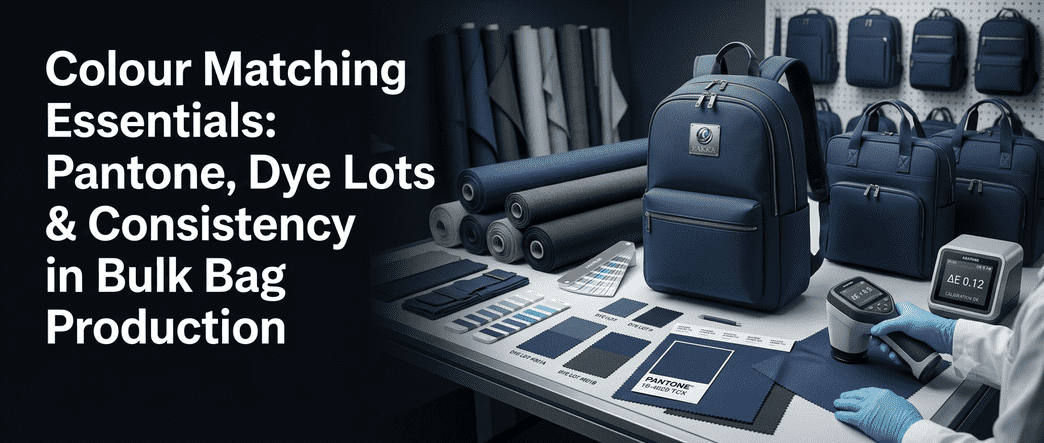
🎨 Colour Matching Essentials: Pantone, Dye Lots & Consistency in Bulk Bag Production
By BAKKA Bags | Bag Authority
🌐 Why Colour Consistency Is a Brand Crisis Waiting to Happen
Colour is your brand's most powerful visual signature. In bag production, even a slight shade variation between batches can:
-
Make a corporate gifting order look unprofessional and sloppy
-
Cause retail buyers to reject an entire 1,000+ unit shipment
-
Create mismatches between bag body, webbing, and trim on the same product
-
Make replacement orders look visibly different from original stock
-
Damage your brand's reputation irreparably in a competitive market
Uncomfortable truth: Colour variation is the #1 quality dispute in bag manufacturing — and it's almost always preventable with the right systems.
🎯 The Colour Complexity Challenge (And Why Bags Are Special)
Unlike a single-fabric garment, a typical bag combines multiple materials that absorb and reflect colour completely differently:
-
Outer fabric — polyester, nylon, canvas, PU leather
-
Lining fabric — often a lighter weave and different fibre composition
-
Webbing & straps — polyester or nylon (often sourced separately)
-
Zipper tape — woven synthetic with limited colour range
-
Rubber patches & emblem — moulded rubber with custom pigment mixing
-
Screen print logos — ink on textured surface
Each material absorbs dye differently. Each has its own colour behaviour. And each must align simultaneously for a cohesive finished bag. This is where colour expertise becomes critical.
1️⃣ Pantone — The Global Language of Colour Precision
Pantone Matching System (PMS) is the internationally recognised standard for communicating colour unambiguously. Instead of vague descriptions like "dark blue," you specify Pantone 287 C — and every supplier across India and globally understands exactly the same colour target.
🗂️ The Pantone Systems for Bag Manufacturing
Not all Pantone systems work for bags. Here's what matters:
|
Pantone System |
Best Used For |
|
Pantone TCX (Textile Cotton eXtended) |
Fabric, lining, webbing, canvas — all textiles |
|
Pantone C (Coated) |
Screen printing on matte bags, labels, branding |
|
Pantone TPG (Textile Paper) |
Metal hardware, rubber patches, trim finishes |
⚠️ BAKKA Rule: Never specify Pantone C for fabric. A colour like PMS 286 C on paper looks dramatically different from Pantone 19-4052 TCX on textile. This single mistake causes 40% of colour disputes in Indian bulk orders.
2️⃣ Dye Lots — The Science Behind Shade Variation
Every dye lot is a batch of fabric dyed simultaneously in the same vat under identical conditions. Yet no two dye lots are ever perfectly identical.
This isn't factory negligence — it's textile chemistry. Variables that affect every dye batch:
-
Water chemistry — pH and mineral content change dye uptake
-
Temperature fluctuations — even 2–3°C shifts alter shade depth
-
Machine calibration — vat capacity and agitation speed affect evenness
-
Fibre origin — cotton from different harvests absorbs dye differently
-
Humidity during drying — post-dye drying alters perceived colour
Practical consequence: If your order uses fabric from three separate dye vats, you could receive three subtly different shades — all technically meeting the same formula.
🔑 The Lot Number: Your Traceability Lifeline
Every dye lot receives a unique lot number. Professional manufacturers use this to:
-
Ensure all panels of a single bag come from the same dye lot
-
Separate and label different lots before cutting
-
Prevent accidental mixing within the same shipment
-
Enable traceability if colour disputes arise
BAKKA Standard: We mandate that all panels for any single bag unit are cut from the same dye lot. A bag where front, back, and side panels come from different lots shows visible shading — unacceptable for professional production.
3️⃣ The Professional Colour Approval Workflow
Great colour consistency is engineered, not left to chance. Here's the disciplined process:
Stage 1: Colour Specification Designer/buyer submits Pantone reference + fabric type to supplier
Stage 2: Lab Dips Factory creates 3–5 small dyed swatches matching the Pantone standard
Stage 3: Lab Evaluation Buyer evaluates lab dips under standardised D65 daylight using a spectrophotometer. Closest match becomes the "Sealed Standard"
Stage 4: Strike-Off Sample Small yardage run on actual production fabric to simulate bulk conditions (flat lab dips behave differently from woven textiles)
Stage 5: Bulk Production Full fabric runs with each new lot measured against the Sealed Standard
Stage 6: Inline & Final QC Random sampling throughout cutting and sewing. Shade bands used to reject fabric outside tolerance
4️⃣ Delta E (ΔE) — Measuring Colour Scientifically
A spectrophotometer produces a numerical value called Delta E (ΔE) — the exact colour difference between two standards.
|
ΔE Value |
What It Means |
Production Grade |
|
ΔE < 0.5 |
Invisible to naked eye |
Luxury standard |
|
ΔE 0.5–1.0 |
Barely perceptible |
Premium standard |
|
ΔE 1.0–2.0 |
Slight difference in side-by-side comparison |
Acceptable for bulk |
|
ΔE > 3.0 |
Obvious mismatch |
Rejection grounds |
BAKKA Rule: For corporate and retail bags, we set maximum ΔE 1.0. For premium lines, ΔE < 0.6.
🚨 Common Colour Mistakes (And How to Avoid Them)
-
❌ Approving colour from a phone photo — screens lie
-
❌ Skipping lab dip approval to save time — forfeits your rejection rights
-
❌ Providing Pantone C codes for textiles — wrong system entirely
-
❌ Mixing dye lots within a single bag — creates visible shading
-
❌ Approving colour under a single light source — always cross-check under D65 daylight AND retail lighting (TL84)
✅ Your Pre-Production Checklist
-
✓ Pantone codes specified (correct system for each component)
-
✓ ΔE tolerance defined in writing
-
✓ Lab dips requested and approved
-
✓ Physical swatch evaluation (not screen-based)
-
✓ Light booth approval under D65 + TL84
-
✓ Sealed master standard retained by both buyer and factory
-
✓ Strike-offs approved for all print elements
🎯 The BAKKA Standard
Colour is your brand's permanent visual identity on thousands of bags. At BAKKA Bags, we treat colour management as engineering — not intuition. We specify Pantone codes for every component. We mandate lab dip approval before bulk production. We define ΔE tolerances in every contract. We inspect under standardised lighting before a single shipment leaves the factory.
When 2,500 bags arrive with your brand colour perfectly reproduced on every unit — that's not luck. That's a system. And it's the BAKKA standard.
📌 Ready to order branded bags with guaranteed colour consistency? Connect with the BAKKA Bags team today for a free colour specification consultation.
Let's Talk Bags
Fill the form and we will connect within 24 hours