Eco-Friendly Certifications Explained: GOTS, OEKO-TEX, GRS & REACH — What Bag Buyers Need to Know
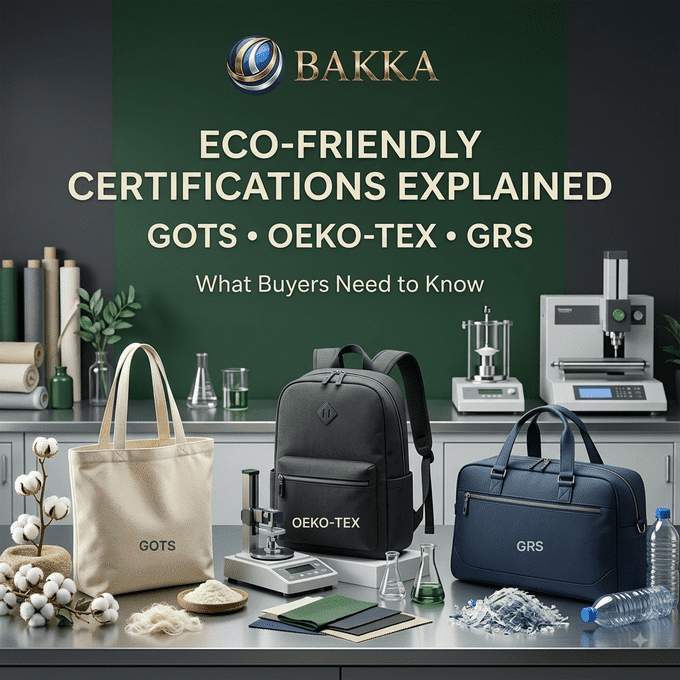
🌱 Eco-Friendly Certifications Explained: GOTS, OEKO-TEX & GRS — What Buyers Need to Know
By BAKKA Bags | India's Bag Authority
The Uncomfortable Truth: Most "Eco-Friendly" Bags Aren't 🚨
Walk through any Indian marketplace today, and you'll see them everywhere: green labels, sustainability slogans, "eco-friendly" claims. But here's what most buyers don't realize—90% of these claims are completely unverified.
A brand slaps a leaf icon on a tag, uses green marketing language, and calls it sustainable. No audits. No third-party verification. No proof.
At BAKKA Bags, we believe sustainability isn't a marketing story—it's a measurable, certifiable commitment backed by independent science. If you can't verify it with a recognized certificate, it's not a product. It's greenwashing.
This guide covers the four certifications that actually matter for bags in India: GOTS, OEKO-TEX, GRS, and REACH. By the end, you'll know exactly how to spot the fakes and find bags built to last.
Why Certifications Matter—Especially in India 🇮🇳
Before diving into the specifics, understand what's at stake:
For Indian Consumers:
-
Your Health: Bags touch your skin, your family's skin, your food. Hidden chemicals—phthalates, formaldehyde, heavy metals—can trigger allergies and long-term health issues, especially in India's hot, humid climate where chemical off-gassing accelerates.
-
Climate Responsibility: Delhi and Bengaluru generate massive textile waste annually. GRS-certified recycled materials divert this directly from landfills.
-
Farmer Protection: Indian organic cotton farmers benefit directly from GOTS standards that eliminate pesticide-heavy conventional farming—a ₹3,000–₹5,000 annual cost savings per hectare.
The Four Certifications Decoded 📋
1. GOTS (Global Organic Textile Standard) — The Farming Gold Standard 🌾
What It Certifies:
GOTS covers the entire supply chain from farm to finished bag, guaranteeing:
-
Zero synthetic pesticides or fertilizers
-
No GMO seeds
-
No hazardous chemicals in processing (dyeing, bleaching, finishing)
-
Fair wages and safe working conditions
-
Proper wastewater treatment
Why It Matters:
"Organic cotton" might sound safe, but here's the catch: organic cotton can still be dyed with carcinogenic azo dyes or finished with formaldehyde. GOTS eliminates this—it's a complete lifecycle certification.
Indian Reality Check:
-
India produces 25% of the world's organic cotton, but most is exported
-
A "100% organic cotton tote" priced at ₹150? Almost certainly not GOTS-certified
-
Genuine GOTS-certified fabric costs ₹200–₹300 per meter (vs. ₹80–₹100 for conventional cotton)
Red Flag: If the bag says "organic cotton" but has no GOTS label, ask for proof. Without a Transaction Certificate, it's unverified.
2. OEKO-TEX® Standard 100 — The Chemical Safety Seal ⚠️
What It Certifies:
OEKO-TEX tests the finished product for 300+ harmful substances:
-
Carcinogenic azo dyes
-
Formaldehyde (causes respiratory issues—a real problem in India's monsoon season)
-
Heavy metals (lead, cadmium, nickel)
-
Phthalates (endocrine disruptors used in plastic coatings)
-
Allergens and sensitizers
Why It Matters:
Your bag lives against your body. If it contains banned chemicals, you're absorbing them through skin contact daily. Polyester bags can be OEKO-TEX certified—this isn't about "organic." It's about safety.
Indian Reality Check:
-
Most budget Indian bags skip this testing to save ₹35,000–₹50,000 per product category annually
-
That "leather-like" smell in cheap PU bags? Often phthalates or formaldehyde off-gassing—worse in India's heat and humidity
-
BAKKA bags pass accelerated humidity chamber tests that simulate monsoon conditions
Red Flag: If a bag touches your skin and isn't OEKO-TEX certified, ask the seller what chemicals it contains. If they can't answer, walk away.
3. GRS (Global Recycled Standard) — The Circular Economy Champion ♻️
What It Certifies:
GRS verifies:
-
Minimum 50% genuine recycled content
-
Complete chain-of-custody (you can trace where your plastic came from)
-
Environmental and labor standards at processing facilities
Why It Matters:
"Recycled polyester" is marketing jargon thrown around carelessly. GRS provides proof—tracking every plastic bottle from a landfill through processing into your bag.
Indian Reality Check:
-
A ₹500 bag claiming "100% recycled polyester"? Highly suspicious. Real GRS-certified fabric costs 15–25% more than virgin polyester
-
India processes massive quantities of global plastic waste, but much is downcycled into low-quality fiber without certification
-
GRS helps divert Delhi and Bengaluru's enormous textile waste streams into productive reuse
The Math: One GRS-certified bag diverts 400–600 grams of plastic from landfills, saves 50–70% water, and cuts carbon emissions by 30–40%.
Red Flag: Recycled claim without GRS certificate + suspiciously low price = likely downcycled or fake.
4. REACH — The Regulatory Baseline 🏛️
What It Certifies:
REACH is EU regulation requiring manufacturers to register all chemicals used and prove they don't harm human health or the environment.
Why It Matters:
REACH compliance is mandatory for EU exports—but here's the critical point: complying for exports should mean all your products are safer, not just the ones shipped abroad.
Indian Reality Check:
-
Many Indian manufacturers maintain two production standards: REACH-compliant for EU exports, non-compliant for domestic sales (cost-cutting)
-
REACH compliance adds 5–10% to manufacturing costs through better chemicals, wastewater treatment, and worker protocols
-
BAKKA ensures all products—domestic and export—meet REACH standards. You deserve the same safety as European buyers.
The BAKKA Certification Commitment ✅
We don't claim to be "the world's most sustainable brand." That would be dishonest. But we do commit to:
-
100% certified transparency: Every eco-claim backed by verifiable certificates
-
Honest labeling: We call conventional materials what they are—never greenwashing
-
OEKO-TEX certifications across all facilities
-
GRS-certified rPET for our sustainable travel line
-
GOTS-certified organic cotton for premium lifestyle bags
-
REACH compliance for every single batch
-
Third-party verification: You can verify our claims independently
Your Procurement Checklist 📋
When evaluating bags, ask for:
-
Third-party certifications (GOTS/OEKO-TEX/GRS)
-
Actual certificates with expiry dates
-
Chain-of-custody documentation
-
Lab test reports for Indian use cases
-
Detailed breakdown of certified materials per component
The Bottom Line 💡
Certifications aren't perfect—but they raise the bar through accountability, transparency, and third-party verification.
Bags without certifications? They're asking you to have faith, not proof.
BAKKA Bags. Certified. Honest. Built for India. 🌱✨
Let's Talk Bags
Fill the form and we will connect within 24 hours