Future of Bag Manufacturing: Why India Will Lead (2026–2029) Copy title
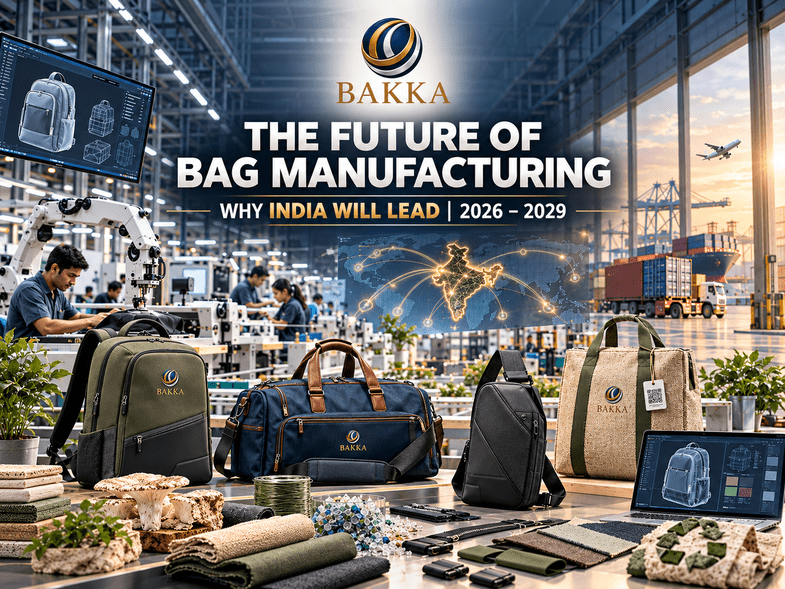
🚀 The Future of Bag Manufacturing: Why India Will Lead (2026–2029)
The Bag Industry Is About to Transform. Most Manufacturers Won't See It Coming.
In the next 5 years, the global bag manufacturing industry will experience a seismic shift. AI-powered design, 3D knitting machines, mycelium leather, and circular manufacturing systems are no longer theoretical—they're actively reshaping production worldwide.
At BAKKA Bags, we're not waiting to adapt. We're leading the transformation. This blog explores what's coming, why Indian manufacturers must prepare now, and how BAKKA is positioning itself (and our partners) for the future.
🌍 Six Mega Trends Reshaping Global Bag Manufacturing
Trend 1: AI-Driven Design & Instant Customization
What's happening right now:
Generative AI tools are compressing design iteration from weeks to hours. A designer inputs requirements ("sustainable, minimal, 18-liter capacity") and the AI generates 100+ variations in minutes.
By 2026–2027:
-
Mass customization becomes viable for batches as small as ₹5–10 lakh orders
-
Design-to-production timelines compress from 6 months to 2–4 weeks
-
Prototyping costs drop 60–70%, making custom bags affordable for mid-market retailers
What This Means for Indian Manufacturers:
✅ Indian designers gain competitive advantage; manufacturing shifts from cost-driven to design-driven
❌ Factories relying on traditional sewing alone become obsolete
BAKKA's Edge: We've already integrated AI tools into our design process. Our average design turnaround? 14 days, not 3 months.
Trend 2: 3D Knitting Eliminates Cutting Waste Entirely
The Problem: Traditional manufacturing wastes 15–25% of fabric through cutting scraps. A ₹1 crore production run loses ₹15–25 lakhs in wasted material.
The Solution: 3D knitting machines create finished fabric tubes in one operation—no cutting, no waste.
By 2026:
-
3D knitting becomes economically viable for runs exceeding 10,000 units
-
Waste drops from 20% to under 2%
-
Production timelines cut by 40%
What This Means for Indian Manufacturers:
✅ Factories investing in 3D knitting gain 15–20% margin improvement
❌ Competitors without automation can't compete on either cost or sustainability
BAKKA's Commitment: We're implementing 3D knitting for 25% of our production by end-2025, targeting 50% by 2027.
Trend 3: Mycelium Leather—Growing, Not Tanning
Traditional leather tanning requires ₹30–50 lakhs per ton in environmental remediation costs. Mycelium leather grows in bioreactors in 2–3 weeks, with zero tanning chemicals.
Current Status (2024–2025):
-
50–100 brands globally testing mycelium leather
-
Cost still 20–30% premium to synthetic alternatives
-
Quality comparable to premium vegan leather
By 2027–2028:
-
Production scales; cost parity achieved
-
Becomes standard for premium/eco-conscious brands
-
Regulatory advantages in EU, India (growing preference)
What This Means for Indian Manufacturers:
✅ Sustainable positioning becomes margin driver, not cost burden
❌ Brands continuing with traditional leather face supply chain scrutiny
BAKKA's Move: Limited edition mycelium leather collection launching Q4 2024; full integration planned for 2026–2027.
Trend 4: Digital Product Passports—Transparency as Competitive Advantage
Every BAKKA bag now includes a Digital Passport (QR code) showing:
-
✅ Exact fabric sourcing location
-
✅ Manufacturing facility and carbon footprint (in kilograms)
-
✅ Repair guides and end-of-life recycling options
-
✅ Certified certifications (GRS, OEKO-TEX, FSC)
By 2026:
-
Transparency becomes table-stakes; customers expect it
-
Retailers demand supply chain visibility for regulatory compliance
-
Brands without passports struggle to secure premium contracts
What This Means for Indian Manufacturers:
✅ Indian transparency + quality positioning = premium pricing power
❌ Opaque supply chains lose institutional buyers
Real Numbers: A BAKKA Bags client recently won a ₹2.5 crore corporate order specifically because our transparency exceeded competitors' capabilities.
Trend 5: Hyperlocal Manufacturing Reduces Shipping Emissions by 80–90%
Instead of centralized production shipping globally, brands will establish regional hubs:
-
India Hub: Design + core production
-
Vietnam Hub: Southeast Asia fulfillment (launching 2025)
-
Mexico Hub: Americas fulfillment (launching 2026)
-
Poland Hub: Europe fulfillment (planning 2027)
Shipping distance drops from 12,000 km to 1,000–2,000 km; delivery timelines compress from 4–6 weeks to 2–3 days.
What This Means for Indian Manufacturers:
✅ India becomes the design and IP center for Asia-Pacific, not just a production node
✅ "Made in India" shifts from cost signal to quality/sustainability signal
✅ Factories can command 20–30% premium margins
Trend 6: Circular Manufacturing—Bags Designed for Infinite Recyclability
Today's Reality: 85% of bags end up in landfills because materials are blended and inseparable.
Tomorrow's Reality: Bags designed for disassembly. Every component is mono-material or easily removable:
-
Straps stitched (not glued), removable in 2 minutes
-
Zippers made from the same material as the exterior
-
Linings sewn, not laminated
By 2027–2028:
-
Circular manufacturing becomes standard for premium brands
-
Brands can offer take-back programs; customers earn credits
-
Zero-to-landfill manufacturing becomes a regulatory expectation
BAKKA's Circular Model: After 3–5 years of use, customers return bags to BAKKA repair shops. Bags are disassembled; 100% of materials re-enter production.
💡 Why India Wins (If We Prepare Now)
India has three structural advantages competitors can't replicate:
-
Cost-Competitive Labor + Skilled Artisans = automation sweet spot
-
Government Support (PLI scheme, SEZs) making investment attractive
-
Digital Infrastructure Ready for Industry 4.0 (UPI, cloud, logistics tech)
But there's a catch: Factories lacking automation, digital systems, and sustainability credentials will lose. Those investing now will capture 40–60% premium margins by 2028.
🏆 What BAKKA Is Doing to Lead the Future
By end-2025, BAKKA will have:
-
✅ 25% of production via 3D knitting
-
✅ 10 regional repair shops (circular economy)
-
✅ 50+ client brands using our AI design platform
-
✅ Mycelium leather collection in 8+ product lines
🎯 The Choice Is Yours
The future isn't coming—it's here, now. The question: Are you leading it or adapting to someone else's innovation?
BAKKA Bags is leading. Will you?
💬 Let's talk about your manufacturer's readiness for 2026–2029. Schedule Your Future-Ready Audit
Let's Talk Bags
Fill the form and we will connect within 24 hours