How Colour Matching Works in Bag Manufacturing: The Complete Guide for Indian Buyers
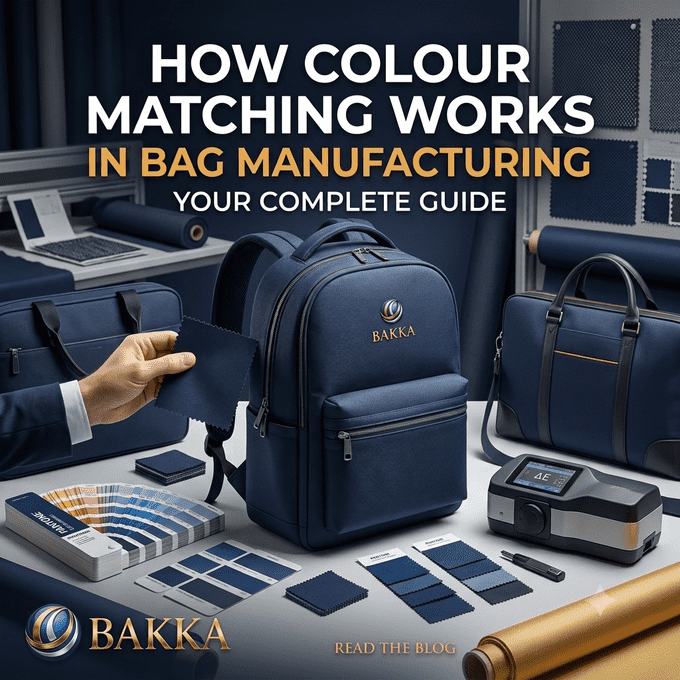
🎨 How Colour Matching Works in Bag Manufacturing: Your Complete Guide
By BAKKA Bags | India's Bag Authority
The Essential Reference for Indian Buyers Who Want Colour Done Right
Your brand colour is locked. The designer is confident. The factory has your brief.
Three months later, 800 corporate gifting bags arrive — and the navy blue body looks completely different from the navy blue logo. The strap has a purple cast. Nothing matches.
This story plays out dozens of times every month in Indian manufacturing.
Here's the truth: colour in bag manufacturing is not visual — it's scientific. It's not about showing your factory a screenshot. It's about using standardised systems, documented approvals, and measured control.
At BAKKA Bags, this is how we ensure perfect colour, every single order. And here's how you can too.
🎯 Why Colour Is More Complex Than It Looks
Your computer screen makes colour simple. But fabric is three-dimensional. It absorbs, reflects, and refracts light differently depending on:
-
Fibre type — Polyester reflects light differently than cotton
-
Material finish — Matte canvas vs. glossy PU leather
-
Light source — Factory LED vs. office fluorescent vs. retail display lights
-
Dye interaction — The same Pantone code dyes polyester and nylon differently
The critical insight: Without a standardised system, colour becomes a guessing game. With one, it becomes reproducible.
📋 The Colour Systems That Matter
1️⃣ Pantone (PMS) — The Global Standard
This is where professional colour communication starts.
Instead of vague language like "navy blue like Kohinoor sapphire," professionals use:
Pantone 286 C
That single code communicates the exact shade across every dye house, screen printer, and factory in India — and internationally.
The Critical Rule: Match the Suffix to Your Material
|
Suffix |
Best For |
Wrong Approach |
|
TCX |
Fabric dyeing (cotton, polyester, nylon) |
❌ Sending Pantone C for cotton |
|
C |
Coated/glossy surfaces (PU leather, vinyl) |
❌ Using TCX for leather items |
|
U |
Uncoated/matte surfaces (canvas) |
❌ Guessing without checking material |
The BAKKA Bags Rule: Most Indian brands send a Pantone C (coated) code for cotton canvas — then wonder why the colour looks dull. Cotton is uncoated and porous. It needs TCX.
Get this wrong, and your entire order is off-colour.
2️⃣ CMYK — For Printing, Never for Dyeing
CMYK (Cyan, Magenta, Yellow, Key Black) is the four-colour printing model. It works by layering tiny dots of ink that your eye blends optically.
Use CMYK for:
-
✅ Screen-printed logos
-
✅ Digital transfer prints (DTF)
-
✅ Sublimation on polyester
-
✅ Heat transfer films
Critical limitation: CMYK cannot reproduce every Pantone colour accurately. Vibrant neons, deep royal blues, and metallics often look duller in CMYK than in Pantone. Always approve a printed strike-off on your actual production fabric — not just a digital proof.
3️⃣ RGB & HEX — Design Only, Never for Manufacturing
❌ Stop sending WhatsApp screenshots and HEX codes to factories.
RGB is light-based colour for screens. It produces colours that are physically impossible to reproduce with dyes or inks. What you see on your monitor does not exist in the real world.
✅ Always convert your brand colours to Pantone before briefing any manufacturer.
🧪 The Lab Dip Process — How Colour Is Approved
A lab dip is a small swatch of actual production fabric, dyed to match your Pantone reference — before bulk production begins. Think of it as a colour proof for fabric.
The BAKKA Bags Lab Dip Workflow:
-
You provide Pantone TCX code + material type (e.g., 600D polyester)
-
Dye house creates 3–5 sample variations on your exact production fabric
-
You review samples under three light sources:
-
☀️ D65 (Daylight)
-
🏪 TL84 (Retail/office lighting)
-
💡 CWF (Cool white fluorescent)
-
Approve the closest match in writing
-
Dye house locks the formula and begins bulk production
Why three light sources? This is your defence against metamerism — the phenomenon where colours look identical under one light but completely different under another.
⚠️ Metamerism — India's Most Overlooked Problem
Imagine: your logo and bag body both approved as "matching" under factory LED lights. Then under your office's cool white fluorescent lights, the bag looks navy and the logo looks purple.
This is metamerism. Different materials absorb and reflect light differently. Without testing under multiple light sources, you won't catch this until bags arrive.
Protect yourself:
-
✅ Always review under D65, TL84, and CWF lights
-
✅ Never approve colour from a photograph or WhatsApp
-
✅ Test all components together (body + lining + straps + logo)
-
✅ Use a light box, not factory ceiling lights
📊 Delta E (ΔE) — The Science of Colour Accuracy
Delta E is the numerical measurement of colour difference, calculated using spectrophotometry (a precision optical instrument). Every professional manufacturing QC uses it.
ΔE Tolerance Standards:
|
ΔE Range |
Quality Level |
Who Uses It |
|
0.0–1.0 |
Luxury premium |
High-end brands |
|
1.0–2.0 |
Export-grade |
International buyers |
|
2.0–3.0 |
Commercial standard |
Bulk orders |
|
5.0+ |
❌ Reject |
Unacceptable |
BAKKA Bags Standard: ΔE ≤ 1.5 for premium corporate orders; ΔE ≤ 2.5 for bulk promotional work.
🏭 Dye Lots — The Hidden Risk
Large orders (500–5,000+ bags) require multiple fabric dye batches. Different dye lots can look subtly different — even with identical Pantone codes.
How to manage:
-
✅ Archive the dye formula from every approved lot
-
✅ Maintain physical approved swatches for 2 years
-
✅ Request lot samples before cutting begins
-
✅ Measure ΔE on each production lot
🎯 The One Sentence That Prevents Colour Disasters
❌ "Make it navy blue."
✅ "Please match Pantone 286 C for screen-printed logo and Pantone 19-3922 TCX for 600D polyester body. Send lab dips on both materials for approval before bulk dyeing."
One sentence. Professional. Unambiguous. Zero surprises.
🔑 The Rules Every Indian Buyer Must Follow
-
Speak in Pantone, not language — "royal blue" means nothing; "Pantone 286" means everything
-
Always match suffix to material — TCX for fabric, C for coated surfaces
-
Never approve colour from a screen — Physical swatches only
-
Check under multiple lights — D65 + TL84 + CWF minimum
-
Archive everything — Lab dips, ΔE records, lot samples, approvals
Final Word 💡
Your brand colour is not decorative — it's a competitive asset. When bags arrive in exactly the right shade, across every component, every time, it communicates precision and professionalism.
When they don't — customers notice. And they judge.
Colour matching is part science, part process, part discipline. At BAKKA Bags, we bring all three to every single order.
Because your colour isn't just your bag's aesthetic. It's your brand's identity. And identity should never be left to chance.
Ready to brief your next order with professional colour management? 🚀
Connect with BAKKA Bags for bulk orders, colour matching guidance, and flawless repeat orders.
BAKKA Bags | Crafted with Purpose. Built to Last. ✨
Let's Talk Bags
Fill the form and we will connect within 24 hours