How to Choose the Right Corporate Bags Vendor: 15-Point Procurement Checklist for Indian Buyers
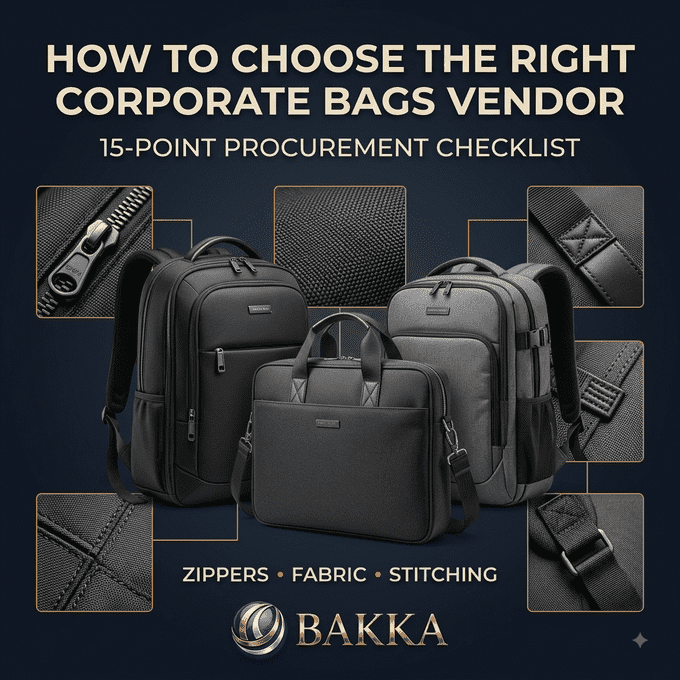
How to Choose the Right Corporate Bags Vendor: 15-Point Procurement Checklist 🎒✨
The Procurement Manager's Challenge 💼
You've been there. A supplier walks in with a slick presentation. The bag sample feels premium. The zipper glides smoothly. The price is "competitive." You place the order for 1,000 units.
Three months later, your CEO's gift bag zipper jams during a client presentation. Your employee's welcome kit seam splits under laptop weight. The fabric develops holes where it rubs against car seats.
The supplier shrugs: "Rough usage."
The real culprit? Specification ambiguity. You didn't know what to ask. They didn't volunteer what they skipped.
At BAKKA Bags, we believe purchase managers shouldn't need a textile engineering degree to buy durable bags. But you do need to understand the three things that separate a 5-year bag from a 5-month bag: Zippers, Fabric, and Stitching.
The Total Cost of Ownership Truth 💰
Price is deceptive.
A ₹1,200 bag might fail within 6 months. A ₹2,500 BAKKA bag lasts 3+ years.
Over five years:
-
Budget bag: ₹1,200 × 5 replacements = ₹6,000 (plus complaints, brand damage) 📉
-
BAKKA bag: ₹2,500 × 1 = ₹2,500 (plus zero complaints, positive reputation) ✅
The difference is what's hidden inside: zipper quality, fabric engineering, and stitching precision.
Part 1: Zippers – 90% of Failures Start Here 🚫
Fact: 90% of bag failures in India involve the zipper, not fabric or seams.
Why Indian Zippers Fail
-
Dust & grit: Indian roads, markets, and construction sites generate fine particles that clog standard zipper teeth
-
Overloading: Users stuff bags 110% beyond capacity; zippers buckle under lateral pressure
-
Cheap materials: Budget bags use zinc alloy teeth that corrode, bend, or snap within months
The Three Critical Zipper Questions
1. "What brand are your zippers?"
If they say "local" or "no brand," proceed cautiously. YKK, SBS, and Opti are global standards.
BAKKA Standard: YKK #8 reverse-coil on all primary compartments. Period. 🎯
2. "Are they reverse-coil or standard coil?"
|
Feature |
Standard Coil |
Reverse-Coil (Better) |
|
Coil Exposure |
Exposed on surface |
Hidden behind tape |
|
Dust Resistance |
Low |
High |
|
Lifespan |
3–6 months |
5+ years |
|
Premium Feel |
❌ No |
✅ Yes |
3. "What size zipper?"
-
#3: Lightweight pockets only
-
#5: Standard main compartments (not ideal for heavy Indian use)
-
#8 or #10: Heavy-duty (BAKKA uses #8 minimum)
Larger gauge = larger teeth that resist jamming and breaking.
The Cost-Benefit Math
Upgrading from a budget #5 nylon zipper to YKK #8 reverse-coil costs ₹35–₹50 extra per bag. It eliminates:
-
Zipper jams 🔒
-
Broken sliders ❌
-
Warranty claims 📞
-
Replacement costs exceeding initial savings 💸
BAKKA Zipper Checklist:
-
✅ Branded (YKK preferred)
-
✅ Reverse-coil construction
-
✅ Size #8+ for main compartments
-
✅ Smooth operation on samples
-
✅ Double sliders on luggage compartments
Part 2: Fabric – "Feels Thick" Isn't Enough 🧵
Purchase teams often judge fabric by touch. But true durability depends on construction, density, and finish—not just thickness.
The Three Numbers That Define Durability
a) Denier (D) – Yarn Thickness
-
Higher denier = generally stronger
-
But: 600D loose weave < 420D tight weave
-
Common specs: 210D–420D (light), 600D–840D (mid-range), 1000D–1680D (heavy-duty)
b) GSM (Grams per Square Meter) – Material Density
-
Never go below 200 GSM for main panels
-
BAKKA rule: 240+ GSM for commuter bags, 280+ for travel bags
c) TPI (Threads Per Inch) – Weave Tightness
-
Higher TPI = tighter weave = stronger fabric
-
BAKKA standard: 18–22 TPI for commuter bags
-
Red flag: Below 14 TPI = weak fabric regardless of denier
BAKKA Fabric Specifications (Indian Use Cases)
|
Bag Type |
Main Panel |
Bottom Panel |
Lifespan |
|
School Bag |
600D / 210 GSM |
840D / 280 GSM |
2–3 years |
|
Commuter Backpack |
840D / 240 GSM |
1680D / 320 GSM |
3–5 years |
|
Travel Duffel |
840D / 280 GSM |
1680D / 360 GSM |
5–7 years |
|
Premium Laptop Bag |
1680D Ballistic |
1680D Ballistic |
7+ years |
Request a written spec card with every order. No guesswork. 📋
Part 3: Stitching – Silent Strength 🔗
The most expensive zipper and thickest fabric are useless if stitching fails.
Key Stitching Metrics
Stitches Per Inch (SPI)
-
Budget bags: 3–4 SPI
-
BAKKA standard: 5–6 SPI on primary seams
Thread Type
-
Budget: Single-ply polyester (breaks under stress, UV degradation in Indian sun)
-
BAKKA: Bonded nylon (40% stronger, UV-resistant, critical for monsoon climates)
Seam Construction
-
Single-needle: Weak, fails under load ❌
-
Double-needle: 2× strength ✅
-
Bar-tacked stress points: Dense zigzag prevents tearing ✅
Strap Attachments (Most Common Failure Point)
-
Budget approach: Straps sewn directly to panel → seam pulls out under load
-
BAKKA approach: Internal webbing extenders (4 inches) + box-stitched + bar-tacked minimum 12 passes
Stitching Checklist for Purchase Teams
-
✅ Main seams are double-needle or flat-felled
-
✅ SPI specified (5–6 minimum)
-
✅ Bonded nylon thread (not standard polyester)
-
✅ Bar-tacks visible at handles, zippers, corners
-
✅ No skipped stitches on samples
-
✅ Internal webbing under strap attachments
-
✅ Even, consistent tension throughout
Your 15-Point Vendor Scorecard 📊
-
✅ Zipper brand specified (YKK preferred)
-
✅ Zipper type: Reverse-coil
-
✅ Zipper size: #8+ on main
-
✅ Fabric denier documented
-
✅ GSM specified (240+ for main)
-
✅ Thread count specified (18+ TPI)
-
✅ Coating type & thickness documented
-
✅ Bonded nylon thread confirmed
-
✅ SPI specified on main seams (5–6)
-
✅ Double-needle stitching on critical seams
-
✅ Bar-tacks visible at stress points
-
✅ Internal webbing under straps
-
✅ PPS (Pre-Production Sample) within 7 days
-
✅ DPI (Design/Production Inspection) at 40% production
-
✅ PSI (Pre-Shipment Inspection) before dispatch
The Bottom Line 💡
A ₹2,500 bag that lasts 5 years is cheaper than a ₹1,200 bag that lasts 6 months.
The difference isn't magic. It's YKK zippers that don't jam, fabric engineered for Indian monsoons and dust, and stitching that doesn't fail.
When you understand what to ask for, procurement becomes strategic. You eliminate complaints. You protect your brand. You make decisions that last.
Ready to Source Smart? 🚀
BAKKA Bags. Specification clarity. Vendor accountability. Zero compromises.
The purchase team's safest decision. ✨
Let's Talk Bags
Fill the form and we will connect within 24 hours