Incoterms 2026 for Indian Bag Buyers — Your Complete Procurement Guide
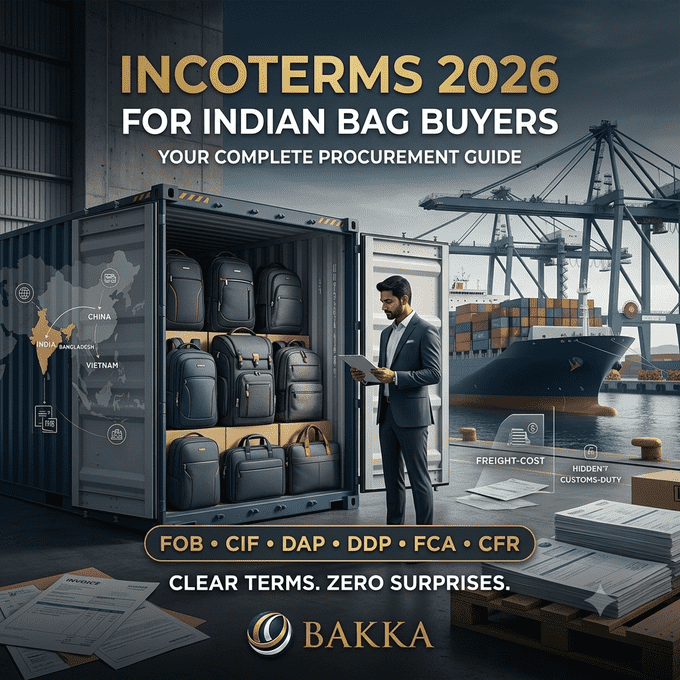
🌍 Incoterms 2026 for Indian Bag Buyers — Your Complete Procurement Guide
By BAKKA Bags | India's Bag Authority
The Scene: Your container lands at Mumbai port. The duty bill arrives: ₹8,50,000. Your budget was ₹6,00,000.
The Question: Who was supposed to pay that?
The Answer: It should have been clear in your Incoterm.
If you're importing bags into India from Bangladesh, Vietnam, or China, understanding Incoterms 2026 is the difference between profitable deals and margin-destroying surprises. At BAKKA Bags, we've worked with Indian corporate buyers who've learned this lesson the hard way. Let us help you learn it the smart way.
📦 Why Incoterms Matter for Your Bag Orders
A bag import involves at least 10 cost layers:
-
Raw materials and manufacturing labor
-
Packing, quality inspection, documentation
-
Transport to port and export customs clearance
-
Ocean freight and insurance during transit
-
Import customs clearance, duties, taxes, and GST
-
Inland transportation to your warehouse
Without a clear Incoterm, every single layer becomes a potential dispute.
The most common disaster? You assume the quoted price includes ocean freight. The seller assumes you'll arrange it. The container sits at Nhava Sheva port for 10 days. Demurrage charges pile up (₹15,000–₹25,000/day per 20ft container). Suddenly, there's an extra ₹1.5 lakh bill nobody expected, and your relationship sours permanently.
7️⃣ The Incoterms That Bag Buyers Actually Use
1. FOB (Free On Board) — The Gold Standard ⭐
What It Means: Seller loads bags onto your nominated vessel at the port. Then it's your responsibility.
Why 80% of Indian Bag Importers Use This:
-
✅ You control ocean freight costs
-
✅ Risk transfers at a clear, verifiable point (Bill of Lading)
-
✅ Industry standard — no ambiguity
-
✅ You can comparison-shop shipping rates
Cost Example: ₹1,050/bag (manufacturing) + ₹30,000–₹50,000 ocean freight for a 20ft container of 10,000 bags.
BAKKA Tip: Always quote FOB with a specific port. "FOB Mumbai Port" (Incoterms® 2020). Generic terms = disputes.
2. CIF (Cost, Insurance & Freight) — Convenience for First-Timers 🛡️
What It Means: Seller pays for freight AND procures minimum insurance to your port. You handle import customs and inland delivery.
The Hidden Trap: The seller's insurance covers only 110% of the CIF value and only total loss. It does NOT cover:
-
Water damage from rough handling
-
Moisture damage during monsoon
-
Theft or pilferage
-
Partial loss
For monsoon-season shipments through high-humidity ports, this is risky. A rain-soaked container can destroy 100% of your bags, but the seller's insurance covers only a fraction.
Our Recommendation: Even with CIF, buy your own all-risk marine insurance. Cost: 0.1–0.3% of cargo value (₹500–₹1,500 on a ₹5,00,000 shipment). Peace of mind? Priceless.
3. DAP (Delivered at Place) — Perfect for Domestic Buys 🏪
What It Means: Seller delivers bags to your warehouse. You handle import customs and unloading.
Best For: Domestic multi-city purchases, where you nominate your carrier.
Example PO Clause: "Incoterm: DAP Sector 4, MIDC, Pune – Building A, Gate 2 (Incoterms® 2020). Seller arranges transport. Buyer clears customs and unloads."
4. DDP (Delivered Duty Paid) — Zero Hassle ✅
What It Means: Seller delivers to your warehouse, cleared for import, all duties paid. You just unload.
Best For: Small promotional orders (500–1,000 units), urgent shipments, or when you don't have customs expertise.
The Trade-off: DDP costs 5–10% more than FOB because the seller must hire Indian customs brokers, assume HS code risks, and manage GST filing.
Avoid DDP If:
-
You import regularly (build customs expertise instead)
-
You're ordering large volumes (savings from FOB/DAP can exceed ₹50,000)
5. EXW (Ex Works) — Maximum Control, Maximum Complexity 🏭
What It Means: Seller makes bags available at the factory gate. Everything else is your problem.
The Hidden Trap: The seller doesn't even load your truck. If the forklift operator is on lunch when your driver arrives, the delay is your problem. Demurrage begins on your truck rental.
BAKKA Recommendation: Avoid EXW unless you have:
-
A dedicated freight forwarder
-
Experience with Indian port procedures
-
Full logistics capacity
6. FCA (Free Carrier) — Perfect for Air Freight 🚚
What It Means: Seller delivers goods to your nominated carrier and clears export customs. You arrange insurance and import clearance.
Best For: Air freight (FOB is sea-only and creates ambiguity), multi-modal shipments, or when you have a preferred freight forwarder.
7. CFR (Cost and Freight) — Seller Pays Freight, You Insure 🚢
What It Means: Seller pays ocean freight but NOT insurance. Risk transfers at sea; you arrange coverage.
Best For: Buyers with strong relationships with marine insurance brokers who negotiate better rates than the seller's minimum cover.
🚨 5 Real Risks Indian Bag Buyers Face
|
Risk |
What Happens |
How to Prevent |
|
Unexpected Demurrage |
Container sits at port; ₹20,000/day charges |
Clarify in PO who pays if container is held; ensure immediate pickup |
|
Customs Reclassification |
Duty rate jumps 10% → 20% for "technical textiles" |
Include HS code in PO (4202.11.00 for bags); work with experienced brokers |
|
Vague Delivery Address |
"DAP Mumbai" → goods land in random Navi Mumbai warehouse |
Always specify: "DAP Sector 4, MIDC, Pune – Building A, Gate 2" |
|
Insurance Gaps |
Goods damaged inland; insurance says it's not covered |
For CIF: verify coverage includes entire journey; for FOB: ensure door-to-door coverage |
|
Delayed Export Docs |
Vessel booking cancels; entire timeline shifts |
Set timelines in PO: "Export documents within 48 hours of loading" |
🎯 How BAKKA Approaches Incoterms: Transparency, Always
Every BAKKA quotation includes:
-
✅ The Incoterm clearly stated (e.g., "FOB Nhava Sheva ICD")
-
✅ A cost breakdown showing exactly what's included
-
✅ The risk transfer point explained in plain language
-
✅ Insurance recommendations based on your season and needs
-
✅ Comparison options (e.g., "FOB = ₹1,050/bag + freight. CIF = ₹1,180/bag, all-in.")
For Domestic Orders: We quote DAP (your warehouse). Price includes everything except GST and unloading.
For Export Orders from India: We quote FOB (Mumbai/Chennai/Nhava Sheva). You arrange freight transparently✅ Your Final Incoterm Checklist
Before placing any order, confirm:
-
Exact Incoterm stated (FOB? CIF? DAP? Always add "Incoterms® 2020")
-
Named place fully specified (port name, terminal, warehouse address)
-
Who pays insurance and when risk transfers
-
Required documents listed (Bill of Lading, invoice, packing list, certificate of origin)
-
Document timelines (e.g., "B/L within 48 hours of shipment")
-
Demurrage responsibility (who pays if container is held)
-
Customs responsibility (who files BoE, who pays if HS code changes)
💡 The Bottom Line
FOB gives you control and cost savings (recommended for repeat importers).
CIF gives you convenience but requires your own monsoon insurance (good for first-timers).
DAP gives you delivery to warehouse (best for domestic multi-city orders).
DDP gives you zero logistics hassle but higher costs (use for small one-offs).
BAKKA Bags' Promise: Every quotation includes crystal-clear Incoterm language. No guessing. No surprises. No disputes.
🚀 Ready to Place a Smart Order?
Contact BAKKA Bags for transparent quotations, Incoterm guidance, and cost comparisons tailored to your logistics setup.
BAKKA Bags. Clear Terms. Reliable Trade. Zero Surprises. ✨
Let's Talk Bags
Fill the form and we will connect within 24 hours