Quality Control Checklist for Bulk Bag Orders: The BAKKA Guide | BAKKA Bags
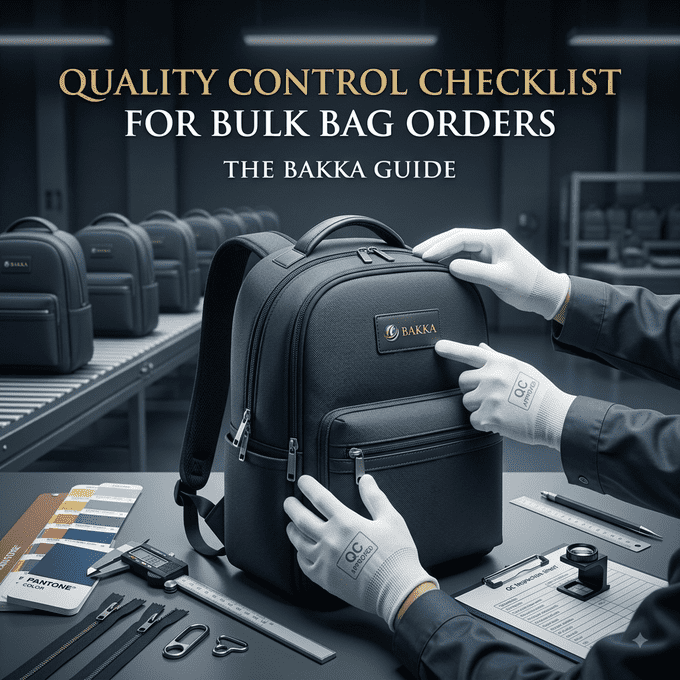
Quality Control Checklist for Bulk Bag Orders: The BAKKA Guide 📋
By BAKKA Bags | India's Bag Authority
Why Bulk Orders Need Iron-Clad QC Standards
In India's fast-paced B2B market, the story is always the same: A corporate buyer orders 500 backpacks for Diwali gifting, approves a sample, waits 45 days, and discovers upon delivery that colors are mismatched, stitches are loose, and zippers jam. The buyer loses ₹2 lakhs. The brand loses trust. The manufacturer loses reputation.
This tragedy is completely avoidable.
At BAKKA Bags, we've learned that bulk orders aren't about faith—they're about engineering and validation. Whether you're sourcing 500 backpacks for corporate gifting, 2,000 school bags for institutional distribution, or 5,000 duffels for e-commerce, quality consistency at scale is what separates reliable partners from the rest.
This is the exact QC framework we use for every BAKKA order. Whether you source from us or hold any manufacturer accountable, use this as your blueprint. 🎯
The Four-Stage Quality Control System
Quality control for bulk orders isn't a final inspection step. It's a complete system spanning raw materials, production, assembly, and shipment. Each stage catches problems before they multiply across thousands of units.
🔍 Stage 1: Pre-Production Material Inspection
The biggest myth in the industry? "Same fabric, same batch equals same quality." Reality: Fabric dye lots vary between rolls. Zipper teeth differ subtly. Webbing tensile strength fluctuates with humidity and storage. Thread twist changes batch to batch.
Here's what we inspect:
-
Fabric Color Matching — Using spectrophotometer against approved Pantone swatches:
-
ΔE < 1.0 = Approved ✅
-
ΔE 1.0–2.0 = Borderline (human review needed)
-
ΔE > 2.0 = Rejected ❌
-
GSM (Grams Per Square Meter) — Must match specs within ±5%. A 5% lighter fabric means significantly weaker wear resistance on Indian pavements and cobblestones.
-
Zipper & Hardware Testing — We test 5% of every batch:
-
Smooth opening/closing without jamming
-
Slider lock strength: minimum 2 kg pull force
-
Prevents accidental unzipping under load during metro commutes or bus rides
-
Webbing & Strap Tensile Strength — Breaking strength measured per cm width. No variance exceeding ±10%.
-
Thread Quality Check — Tension, twist count, and material (polyester vs. nylon). Inconsistent thread tension causes puckering and loose stitches later.
BAKKA Insight: Never trust just the master sample. The sample is a promise. The incoming material batch is the truth. We photograph and document every material batch with reference codes. 📸
⚙️ Stage 2: In-Process Quality Control (Production Line)
This is the critical window where most failures originate. A faulty cutting pattern, misaligned zipper, or weak seam on the production line multiplies across hundreds of units before final inspection catches it.
What we monitor:
-
Cutting Precision — Panels must match CAD patterns within ±1 mm. Warped cuts lead to:
-
Zippers that don't align straight
-
Uneven bottoms (bags won't stand upright on metro platforms)
-
Wasted material and rework costs
-
Seam Inspection — Every 50th bag is pulled randomly from the line:
-
Stitch Count: Minimum 4 SPI (Stitches Per Inch) on main seams; 5–6 SPI for load-bearing areas
-
Seam Flatness: No tunneling or puckering
-
Stress Point Reinforcement: Double-stitched corners with bartacks at handles and zipper ends
-
Zipper Alignment — The track must sit perfectly straight. Even a 2 mm diagonal causes jamming during daily use.
-
Handle Pull Tests — Every handle anchor receives a 5 kg tug force. Acceptable displacement: < 2 mm. Anything more gets reworked immediately.
BAKKA Insight: In-process checks cost far less than rework. If we spot a cutting issue on unit #50, we stop the line, fix the template, and inspect units #50–#100 before resuming. 🛑
🧪 Stage 3: Functional Testing Lab
Once assembled, bags enter our stress chamber simulating real Indian usage conditions:
|
Test |
Standard |
Why It Matters in India |
|
Drop Test |
1.2 m drop on concrete, 3 cycles |
Bags fall from shelves, auto-roofs, train compartments |
|
Load Test |
1.5× stated capacity, held 5 minutes |
School bags stuffed with books; professional bags with laptops |
|
Abrasion Test |
10,000+ rub cycles |
Bags dragged on cobblestones, metro floors, rough pavements |
|
Zipper Durability |
500 open/close cycles |
Daily commute stress; no jamming or separation allowed |
|
Water Resistance |
5-minute water spray |
Monsoon downpours and humidity across India |
|
Seam Strength |
> 200 Newtons (≈20 kg weight) |
Seams hold under real-world loading |
Critical Decision: If any unit fails, we stop production immediately and trace the root cause globally. We don't move forward with assumptions. 🚫
✨ Stage 4: Final Visual Inspection & Packaging
The last mile reveals hidden defects. A structurally sound bag might fail due to cosmetic issues that make it unfit for corporate gifting.
What gets inspected:
-
Thread Trimming — All loose threads cut to zero (no tails > 2 mm)
-
Logo Alignment — Logos parallel to seams within ±2 mm (critical for corporate standards)
-
Color Consistency — Random bags from different production days compared using the same spectrophotometer
-
Zipper Functionality — 10 open/close cycles per bag; must be smooth and silent
-
Dimensions — Width, height, depth verified to ±5 mm against approved specs
-
Protective Packaging — Individual poly bags with silica gel packets (essential for monsoon transit) 📦
Sampling Plan (ISO 2859-1):
-
Orders < 500 units: Sample 20–30 units
-
500–5,000 units: Sample 50–125 units
-
5,000+ units: Statistical sampling per ISO
The Pre-Production Sample (PPS): Your Insurance Policy
Before production starts, you receive and approve a Pre-Production Sample including:
-
Physical prototype made from actual production materials
-
CAD technical drawing with exact dimensions
-
Pantone color swatch and hardware samples
-
Logo placement and packaging specification
Your approval is ironclad. Any deviation from the approved PPS triggers full rework. 🔒
The Math: Why Quality Control Saves You Money 💰
Consider poor quality on a 5,000-unit order:
|
Scenario |
Direct Cost |
Hidden Cost |
Total Loss |
|
5% defect rate (250 units) |
₹50,000 |
Returns, brand damage |
₹2,00,000+ |
|
Zipper failures post-delivery |
₹25,000 |
Customer complaints |
₹1,50,000+ |
|
Color mismatch (half the order) |
Full rework |
Missed deadlines, freight |
₹3,00,000+ |
Investment in upfront QC: ₹20,000–30,000 (< 2% of order value)
Prevents potential loss: ₹2,00,000–5,00,000+ (200–500% ROI) 📈
Red Flags: What to Demand from ANY Manufacturer
Ask before production:
-
✅ Can we formally sign off on a Pre-Production Sample?
-
✅ Will you provide written material and construction specifications?
-
✅ Do you conduct in-process checks, or only final inspection?
Ask before shipment:
-
✅ Will you provide a digital QC report with photos?
-
✅ Do you offer replacement guarantee for post-delivery defects?
Red flags:
-
❌ "The sample IS the production quality" — One sample never represents 5,000 units
-
❌ "We only do final visual inspection" — Too late for systemic issues
-
❌ "No QC reports; just trust us" — Professional manufacturers document everything
-
❌ "We can't do sample approvals" — Reputable suppliers always start with PPS sign-off 🚩
Ready for Your Next Bulk Order?
BAKKA Bags eliminates the gap between sample and production. Because in the Indian market, a broken zipper on day one isn't a defect—it's a brand failure. ⭐
Connect with our B2B team for a consultation, sample QC walkthrough, and a customized quality agreement tailored to your needs.
Because quality at scale matters. And reliability is non-negotiable. 🏆
Let's Talk Bags
Fill the form and we will connect within 24 hours