Quality Control Checklist for Incoming Bag Shipments: The BAKKA Authority Guide
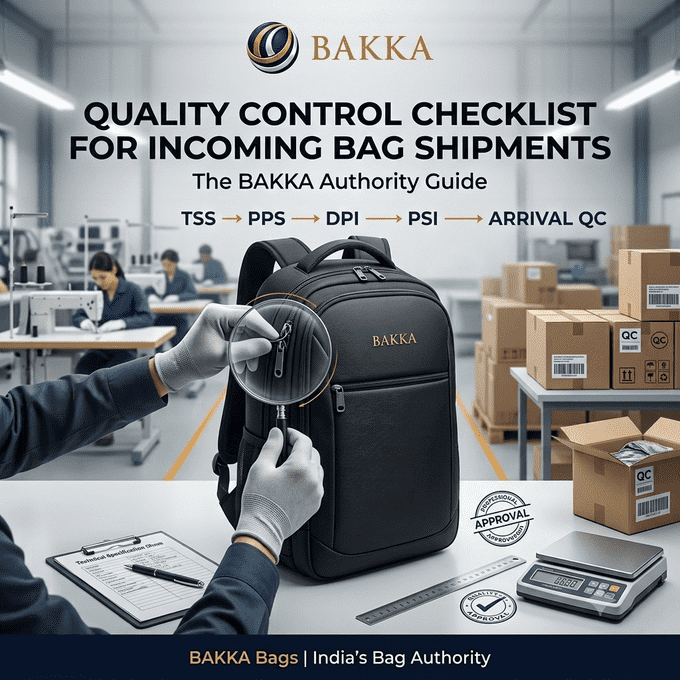
🎒 Quality Control Checklist for Incoming Bag Shipments: The BAKKA Authority Guide
By BAKKA Bags | India's Bag Authority
Your sample was flawless. Your bulk order arrived with loose threads, jammed zippers, and crooked logos.
Sound familiar? Every procurement manager in India has faced this nightmare—and it costs ₹50,000 to ₹5,00,000 in rework, delays, and reputational damage.
The problem isn't bad luck. It's the absence of a quality control framework before production even starts.
Here's what we've learned after manufacturing 500,000+ bags for corporate buyers, NGOs, and retailers across India: quality control isn't enforced after manufacturing—it's engineered into every stage of production, right from day one.
This is BAKKA's proven QC checklist. Use it with any supplier to guarantee your incoming shipments meet exact standards.
🌍 Why Indian Bulk Orders Demand Aggressive QC
Bags manufactured for Indian buyers face unique, unforgiving conditions:
-
Monsoon Season (June–September): Humidity weakens coatings, rusts hardware, triggers mold. Your bags must repel water, not absorb it.
-
Extreme Heat: Delhi hits 50°C in summer. Adhesives fail. Thread weakens. Colors fade unevenly.
-
Dust & Abrasion: Construction sites, highways, crowded metros—bags endure constant friction against concrete, metal, and dirt particles that clog zippers.
-
Overloading Culture: School bags stuffed with ₹15,000 of textbooks. Corporate backpacks crammed with files and laptops. Travel bags packed beyond stated capacity. Your bags must survive 150% of advertised load.
-
Volume Risk: A 2% defect rate on 5,000 units = 100 broken bags damaging your Diwali gifting program reputation in one shipment.
-
Zero Rework Time: Diwali orders have 60-day windows. Monsoon logistics are unpredictable. No time to rework a failed batch.
Bottom line: Standard QC isn't enough. You need the BAKKA system.
🚪 The Five-Stage QC Gate System
Quality isn't one checkpoint—it's five strategic gates that catch defects at the lowest cost and earliest stage.
Stage 1: Technical Specification Sheet (Before Purchase Order) 📋
Most buyers write vague POs: "Premium quality," "durable," "like the sample." Suppliers interpret this however they want.
Solution: Create a Technical Specification Sheet (TSS) signed by both parties before production starts.
Your TSS must include:
|
Component |
What to Specify |
Indian Example |
|
Main Fabric |
Denier, GSM, coating type/thickness |
600D polyester, 240 GSM, 20-micron PU coating |
|
Base Panel |
Heavier reinforcement for overloading |
840D polyester, 280 GSM (30% heavier) |
|
Zipper |
Brand, size, mechanism |
YKK #8 coil, reverse slider (survives 500+ cycles) |
|
Stitching |
SPI (stitches per inch) |
5-6 SPI on main seams, double-needle lock |
|
Hardware |
Finish quality for humidity |
Zinc alloy, nickel-plated, matte (resists rust) |
|
Dimensions |
Finished size with tolerance |
40cm (H) × 30cm (W) × 15cm (D), ±1cm |
BAKKA Rule: No signed TSS = No production starts.
Stage 2: Pre-Production Sample (PPS) Approval ✨
Suppliers craft a handmade sample using premium materials. Then they manufacture 5,000 units using faster processes and cheaper shortcuts.
Solution: Demand the PPS be cut from the exact same materials and production line used for bulk manufacturing.
Your PPS inspection checklist:
-
✅ Fabric color matches Pantone reference under daylight (not office lights)
-
✅ Stitching density matches TSS (count the stitches on 1 inch of seam)
-
✅ Zipper slides smoothly 30 times without jamming
-
✅ Hardware is scratch-free, non-rusty, properly aligned
-
✅ Dimensions measured with ruler—within ±1cm of spec
-
✅ Logo/print is sharp, centered, color-correct
-
✅ Padding (if applicable) is evenly distributed, 5mm thickness
Approve in writing: "Pre-Production Sample approved by [Name] on [Date]. All bulk production must match exactly. Any deviation requires written approval."
Stage 3: During Production Inspection (DPI) at 30-50% Completion 🔍
Stop production at halfway point. Why? Because discovering a systemic defect after 50% completion costs ₹2,00,000 in rework—whereas catching it early costs ₹20,000 in adjustments.
Your DPI checklist:
-
First-Piece Inspection: The very first bag off the line must match PPS exactly. If it fails → STOP production immediately.
-
Inspect 10% of Units at three stages:
-
After fabric cutting (check pattern match, edge finishing)
-
After stitching (seam quality, no skipped stitches)
-
Before final assembly (zipper placement within 1.5mm, pocket alignment)
-
If >2% show major defects → Issue Corrective Action Plan (CAP), stop production, re-inspect.
Stage 4: Pre-Shipment Inspection (PSI)—The Critical Gate ⚠️
This is where most suppliers cut corners. PSI defines your acceptance criteria using AQL (Acceptable Quality Limit).
AQL Tiers:
|
Defect Type |
Definition |
Industry Standard |
BAKKA Standard |
|
Critical |
Safety hazard, broken zipper, missing handle |
0% |
0% |
|
Major |
Loose seam >3mm, color mismatch >2 shades |
2.5% |
1.0% |
|
Minor |
Loose thread >1cm, slight stitch unevenness |
4.0% |
2.5% |
Meaning: Order 5,000 bags with 1.0% AQL for major defects? You accept maximum 50 defective units. More than 50 found = batch FAILS.
Your PSI demands:
-
✅ 100% visual inspection of all bags before packing
-
✅ 10-50 unit random sample for AQL verification (depends on batch size)
-
✅ Functional tests on random sample:
-
Zipper cycle 200 times (no jamming, no separation)
-
Drop test: Fill to 110% capacity, drop 1.2m onto concrete 6 angles
-
Load test: Hang 30kg weight on shoulder strap for 1 minute
-
Abrasion test: Rub base panel 500 cycles on rough surface
-
Water resistance: Pour water on fabric—it must bead/repel (monsoon protection)
-
✅ Lab tests (if required):
-
Seam tensile strength: 200+ Newtons (equivalent to 20kg hanging weight)
-
Abrasion resistance: 50,000+ Martindale cycles before visible wear
-
Colorfastness: Color shift <1.5 ΔE units after 20 wash cycles
Stage 5: On-Arrival Spot Check 📦
Even after PSI, verify. Open 3-5 random cartons at your warehouse. Check:
-
Bag condition matches pre-shipment inspection
-
No shipping damage (dents, creases, water exposure)
-
Packaging labeling matches PO number and quantity
-
Hardware, zippers, logos all intact
💯 The BAKKA Difference
We share this checklist because informed buyers are empowered buyers. When you order from BAKKA Bags:
-
✅ Every order starts with a signed Technical Specification Sheet
-
✅ Every fabric batch is tested before cutting (GSM, color, denier)
-
✅ Every production line is inspected at first-piece, DPI, and PSI stages
-
✅ Every unit passes 100% visual inspection + 10% functional sampling
-
✅ Every shipment includes a digital QC report with photographs
Our guarantee: <0.5% defect rate | 100% replacement guarantee | Zero loose seams or jammed zippers.
🎯 Your Action Plan
Today: Use this checklist to audit your current supplier.
Next Order: Send this checklist with your PO. Demand TSS sign-off, DPI approval, and PSI documentation.
With BAKKA: Contact us for customized QC checklists by bag type (school, corporate, travel, NGO). We'll show you reference customers with published quality metrics.
BAKKA Bags. Quality controlled. Verified. Guaranteed. ✨
Let's Talk Bags
Fill the form and we will connect within 24 hours