Quality Control in Bag Manufacturing: Tests, Defect Rates & Acceptance Criteria
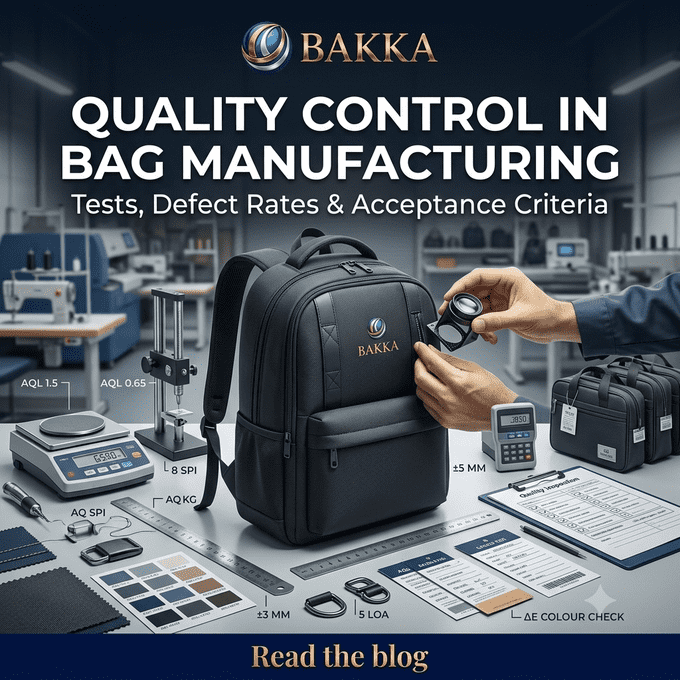
🎒 Quality Control in Bag Manufacturing: Tests, Defect Rates & Acceptance Criteria
By BAKKA Bags | India's Bag Authority
The Purchase Order said 1,000 pieces. The delivery counted 1,000 pieces. The invoice showed 1,000 pieces.
But when a Delhi-based gifting company opened the cartons for their annual conference bags, only 847 bags were acceptable. One hundred and fifty-three had defects — cracked logos, misaligned prints, broken zippers, weak stitching, and colour inconsistencies. No single defect was catastrophic. Every single one was preventable.
The factory claimed to have a "quality team" and conducted a "final inspection." What they actually had was guesswork dressed up as quality control.
This is not unique to that factory. It's the reality across India's bag manufacturing sector.
At BAKKA Bags, quality control is not an activity — it's a science. Built on standardized tests, measurable acceptance criteria, and zero-ambiguity defect classifications. This is our complete technical framework.
🧪 Why Visual Inspection Alone Isn't Quality Control
A worker looking at a bag and saying "It looks good" is not quality control. It's subjective assessment — influenced by fatigue, production pressure, and familiarity bias.
Real quality control is objective, documented, and measurable.
At BAKKA Bags, we verify quality through:
-
Quantifiable tests (stitch density in SPI, pull strength in kilograms, colour deviation in ΔE units)
-
Documented acceptance criteria (the precise defect limit that separates "pass" from "fail")
-
Statistical sampling (we inspect the right quantity of bags to achieve 95% confidence in the entire batch)
-
Measurable results (every test produces a number, a photograph, or a signed inspection report)
📊 How We Determine Batch Quality: AQL Standards
Acceptable Quality Level (AQL) is the industry standard that defines how many defects a batch can contain and still be accepted.
For BAKKA Bags:
-
Major defects (e.g., broken zipper, torn seam, wrong logo): AQL 1.5 — maximum 1.5% defects allowed
-
Minor defects (e.g., loose thread, small scuff): AQL 4.0 — maximum 4% defects allowed
-
Critical defects (e.g., open seam, misspelled logo): AQL 0.65 — maximum 0.65% defects allowed
What does this mean practically?
For a 1,000-bag order, we inspect a scientifically determined sample of 80–125 bags. If we find 3 major defects in that sample, the entire batch fails and requires 100% sorting.
This is not subjective. This is statistical quality assurance.
🧵 The BAKKA Bags Test Battery
Every bag we produce passes through five categories of rigorous testing:
✅ Test 1: Construction & Stitching
Stitch Density (SPI): Shoulder strap seams must have minimum 8 SPI (stitches per inch). Box-X reinforcement requires 10–12 SPI. Measured and verified on every production batch.
Seam Strength: We apply 15 kg of force to shoulder strap attachments for 60 seconds. The seam must hold without thread breaking, fabric tearing, or strap separation.
✅ Test 2: Hardware & Zippers
Zipper Endurance: Every zipper cycles minimum 50 times to ensure smooth operation. The slider must not jam, separate, or come off the chain.
Buckle & D-Ring Testing: Metal buckles undergo 15 clip-and-unclip cycles under stress. Any cracking, splitting, or deformation = rejection.
Corrosion Resistance: For bags destined for coastal cities (Mumbai, Chennai, Kochi), hardware is tested in 5% saline solution for 8 hours. Zero visible rust or plating failure is non-negotiable.
✅ Test 3: Material & Fabric Quality
GSM Verification: This is critical in India's domestic supply chain. Fabric substitution is common. We measure every fabric roll received at three positions to confirm GSM (grams per square metre):
|
Specified GSM |
Acceptable Range |
|
600 GSM |
575–625 GSM (±4.2%) |
|
420 GSM |
400–440 GSM (±4.8%) |
|
300 GSM |
285–315 GSM (±5%) |
Any roll below the minimum threshold triggers an immediate batch hold and supplier notification.
Colour Fastness: Dark-dyed bags undergo a rub test — wet and dry — to ensure colour does not transfer to clothing or adjacent surfaces.
✅ Test 4: Branding & Print Quality
Print Adhesion (Tape Peel Test): We apply standard adhesive tape over the logo, press firmly for 30 seconds, then pull at 90 degrees. The print must show zero ink transfer and zero cracking. Any ink on the tape = rejection.
Logo Placement Accuracy: Using steel rulers and approved artwork specifications, we verify:
-
Distance from edge: ±3 mm tolerance
-
Logo height/width: ±2 mm tolerance
-
Rotational alignment: ±1 degree
✅ Test 5: Dimensional & Functional Performance
Dimensional Accuracy:
|
Bag Size |
Tolerance |
|
Small (<30 cm) |
±3 mm |
|
Medium (30–45 cm) |
±5 mm |
|
Large (>45 cm) |
±8 mm |
Load Test: We load the bag to 5 kg minimum (or its rated capacity), lift by straps for 5 minutes, then drop from 75 cm height onto concrete. The bag must survive with no seam opening, strap separation, or zipper failure.
📋 India-Specific Quality Considerations
India's market has unique conditions that global QC frameworks miss:
🌧️ Monsoon Performance: June–September monsoon rains demand water-resistance testing for South Indian, Western, and Eastern markets. We conduct rain spray protocols on all coastal-distributed bags.
☀️ Heat Durability: Indian summer temperatures reach 40–47°C. PU leather and coated fabrics must survive 4-hour exposure at 60°C (simulating a car parked in peak summer). Low-grade coatings fail here.
🎒 High-Load Daily Use: Indian school bags carry 6–8 kg daily. Commuter backpacks on Mumbai locals and Delhi Metro face crushing forces beyond Western "urban" specifications. Our pull tests are calibrated for Indian reality.
🔄 Supply Chain Substitution: Domestic fabric suppliers often downgrade GSM between sampling and bulk delivery. Our incoming fabric testing catches this fraud before production begins.
📌 What Buyers Should Demand
When sourcing bags from any manufacturer, ask for:
-
✅ Written AQL standard and sample size methodology
-
✅ Signed inspection reports from the last three orders
-
✅ GSM test results for incoming fabric
-
✅ Zipper cycling and hardware endurance records
-
✅ Branding strike-off approval documents
-
✅ Pre-shipment inspection reports with photographs
A manufacturer who cannot answer these questions confidently is practising "quality by hope," not quality by science.
🏆 The One Metric That Defines Quality
After all the tests and criteria, one number reveals everything: post-delivery defect return rate.
Not internal inspection pass rates. Not pre-shipment percentages. The actual percentage of bags that clients report as defective after distribution.
At BAKKA Bags, we track and publish this metric — because accountability is what separates thought leaders from average manufacturers.
📝 Final Word
The gap between India's best bag manufacturers and its weakest is not a gap of intention. It's a gap of system — between those with defined, documented quality processes and those relying on experience and hope.
Quality is measurable. Demand the measurements.
BAKKA Bags | Crafted with Purpose. Built to Last. 🎯
Connect with our Quality Assurance team for a consultation on your bulk bag order.
Let's Talk Bags
Fill the form and we will connect within 24 hours