Quality Control in Bag Production: AQL Levels, QC Checklists & Factory Audit Guide for B2B Buyers
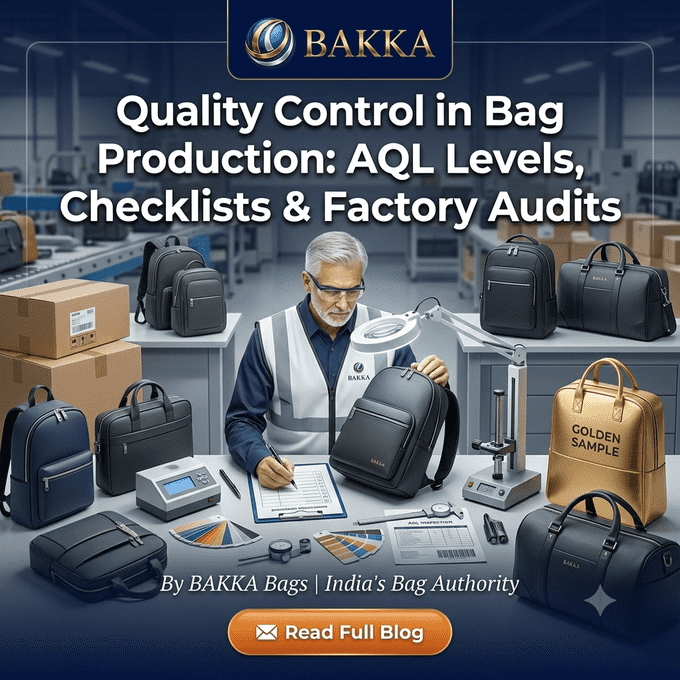
🎯 Quality Control in Bag Production: AQL Levels, Checklists & Factory Audits
By BAKKA Bags | India's Bag Authority
That moment is painfully familiar: 10,000 bags arrive at your warehouse, and within hours, you discover 800 units with broken zippers, misaligned stitching, and colour variations your customers will absolutely reject. By then, the damage is done — reorders delayed, brand reputation dented, logistics costs soaring.
The real problem? A quality control system that was never built in the first place. 🏭
At BAKKA Bags, quality control isn't a department—it's a discipline that runs from the moment raw materials arrive at the factory to the moment the shipping container seals. This guide gives Indian procurement leaders, brand managers, and corporate buyers the exact framework needed to protect their brand, budget, and business relationships.
💼 Why Quality Control Costs Less Than Quality Failures
A single shipment failure cascades far beyond defective units:
-
📦 Return logistics — Often exceeding the original unit cost by 2–3×
-
⏰ Reorder delays — Breaking event deadlines and campaign windows
-
📉 Brand reputation damage — A poorly made bag with your logo becomes visible liability
-
💰 Retailer chargebacks — Global standards impose 15–25% financial penalties for non-conforming shipments
-
🔗 Supplier relationship deterioration — Without documented standards, disputes have zero resolution path
The most profitable sourcing teams aren't those with the strictest inspectors—they're the ones with the clearest specifications, most thorough supplier selection, consistent inline monitoring, and transparent post-shipment reviews.
🏢 The Four-Stage BAKKA Quality Control Architecture
Quality control in bag manufacturing isn't a single inspection event. It's a multi-stage sequential process that catches problems at the earliest and cheapest point:
Stage 1️⃣ — Incoming Material Inspection (IQC) 🏭
This is where quality is built in or permanently compromised. No amount of skilled sewing compensates for defective zippers or off-shade fabric.
IQC Verifies:
-
Fabric: GSM weight (300–600 gsm range typical), denier count, weave consistency, shade matching
-
Zippers: Smooth operation, slider integrity, puller strength, brand verification (YKK vs. generic)
-
Hardware: Buckle function, D-ring gauge, rivet thickness, plating consistency
-
Webbing: Tensile strength ≥ 500 N/50mm, width consistency, colour accuracy
-
BAKKA Rule: All fabric for a single production run must come from the same dye lot—verified at IQC before cutting begins. This single protocol eliminates 60% of colour variation complaints.
Stage 2️⃣ — Inline Production Inspection (IPQC) 🧵
This is where a seasoned QC team earns its value. A defect caught at the sewing machine costs ₹5–₹10 to fix. The same defect found during final inspection costs ₹50–₹100 to remedy. The same defect found by your customer? Reputation damage priceless.
IPQC Standards:
-
Pull minimum 10% of production at random intervals from active sewing lines
-
Stitch density: 8–10 SPI (stitches per inch) for fabric; 5–7 SPI for leather
-
Back-tacking at all seam start and end points (minimum 3 stitches)
-
X-Box stitch reinforcement at all stress points—handle attachments, strap anchor points, D-ring loops
-
Panel alignment and symmetry verified against Golden Sample using measurement templates
-
Any recurring defect triggers full line stop and documented root cause investigation
Stage 3️⃣ — Final Random Inspection (FRI) ✅
When 80–100% of production is complete, FRI applies AQL (Acceptable Quality Limit)—a statistical sampling methodology based on ISO 2859-1 that determines: How many defects in a sample justify batch rejection?
Critical Point: AQL is NOT your target. It's your rejection threshold. Aim for zero. Use AQL as your safety net.
FRI Checks:
-
Full functionality testing of every component
-
Carton drop test—box integrity under simulated shipping (( 1.2m ) height)
-
Dimension measurements (tolerances: ±3–5mm for totes; ±5–8mm for backpacks)
-
Barcode and label accuracy
-
Final visual appearance—cleanliness, hardware condition, thread trimming (≤2mm standard)
Stage 4️⃣ — Container Loading Inspection (CLI) 📦
The final gate before your bags leave India.
-
Verify correct carton count against packing list
-
Inspect carton condition—zero moisture damage, crushing, contamination
-
Check container condition—no odour, moisture, pest evidence
-
Ensure moisture protection: silica gel packs for ocean freight (critical in Indian humidity)
-
Document everything before container seal
📊 Understanding AQL: Your Quality Control Backbone
AQL is the international standard that tells you exactly when to reject an entire batch based on defects found in a random sample.
The Three Defect Categories 🚨
🔴 Critical Defects — AQL: 0 (Zero Tolerance)
-
Exposed sharp metal, toxic chemical odour, needles in padding, wrong branding
-
One critical defect = automatic batch rejection
🟡 Major Defects — AQL: 2.5
-
Broken zippers, skipped stitches, handle pull-out, hardware rust
-
Renders bag non-functional
🟢 Minor Defects — AQL: 4.0
-
Loose thread ends, slight logo off-centre, small scuffs on non-visible surfaces
-
Cosmetic only; doesn't affect use
Sample Size Reference (Indian Order Context) 📋
|
Lot Size |
Sample Size |
Critical |
Major |
Minor |
|
≤200 |
32 |
0/1 |
2/3 |
5/6 |
|
201–500 |
50 |
0/1 |
3/4 |
7/8 |
|
501–1,200 |
80 |
0/1 |
5/6 |
10/11 |
|
1,201–3,200 |
125 |
0/1 |
7/8 |
14/15 |
🛡️ The Golden Sample: Your Single Most Important QC Tool
Before production begins, create a Golden Sample—a physically perfect, fully approved bag that serves as:
-
Visual standard for all comparison checks
-
Colour reference for fabric, thread, hardware, and branding
-
Dimensional template for all measurements
-
Dispute resolution document if quality is challenged
BAKKA Rule: The Golden Sample must be physically present on the production floor throughout the entire production run—not photographed on a phone, not stored in an office. Present. Every day.
✅ Before You Ship: The Pre-Shipment Verification Checklist
-
✅ Golden Sample approved and signed by both parties
-
✅ AQL level locked into Purchase Order
-
✅ IQC completed; raw materials approved before cutting
-
✅ Inline inspection at ≥10% pull rate
-
✅ First-article inspection on first 20 units
-
✅ Final Random Inspection at approved AQL
-
✅ All Critical defects = 0; Major and Minor within thresholds
-
✅ Container Loading Inspection completed and documented
🎯 Final Word: Quality Is Built, Not Inspected In
The brands receiving shipments they're proud of aren't the ones with strictest inspectors. They're the ones with clearest specifications, most thorough supplier selection, most consistent inline monitoring, and honest post-shipment reviews.
At BAKKA Bags, we engineer quality in—through rigorous material sourcing, disciplined inline checks, zero tolerance for critical defects, and transparent QC reporting that gives you full visibility from the cutting room to the container.
Because a bag carrying your brand should be something you're proud to see in the world—not something you're managing a return for. 🌟
📩 Ready to build a quality-first bag supply chain? Share your specifications, order volumes, and quality requirements—and our team will walk you through our complete QC protocol and show exactly how we protect your brand at every stage.
BAKKA Bags — Manufactured with Discipline. Inspected with Integrity. Delivered with Confidence. ✨
Let's Talk Bags
Fill the form and we will connect within 24 hours