Sustainable Bag Manufacturing in India: The Complete B2B Guide to Eco-Friendly Materials, Certifications & Responsible Sourcing
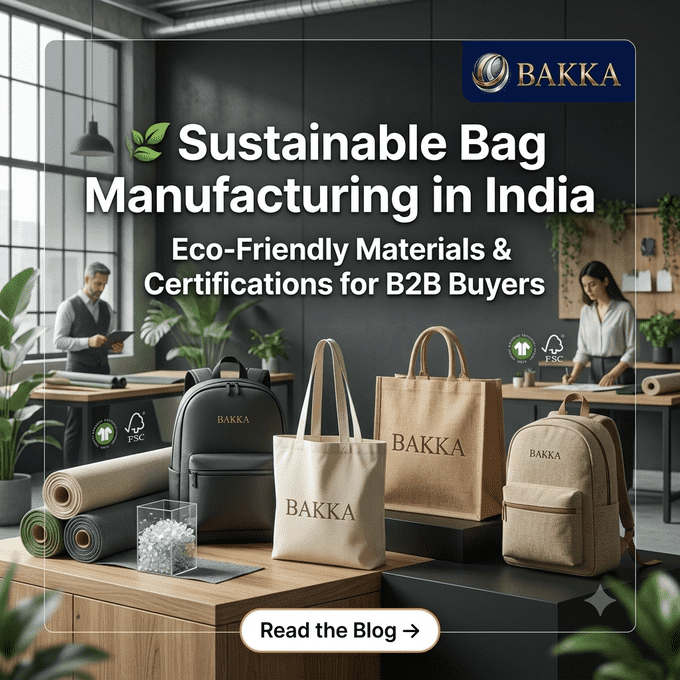
🌿 Sustainable Bag Manufacturing in India: A B2B Guide to Eco-Friendly Materials & Certifications
For Procurement Leaders, Brand Managers & Corporate Buyers — by BAKKA Bags
By BAKKA Bags | India's Bag Authority
Sustainability has transcended from a buzzword to a business imperative in bag sourcing. Whether you're a retailer in Mumbai, a corporate buyer in Bangalore, or an NGO operating across India, your supply chain decisions now carry legal, reputational, and market consequences.
At BAKKA Bags, we've guided hundreds of Indian and international clients through this landscape. Here's what actually matters when sourcing sustainable bags at scale — backed by global standards and adapted for India's unique manufacturing context.
🏛️ Why Indian Brands Must Act Now on Sustainability
Three pressures are reshaping the bag industry simultaneously:
1. Global Regulatory Compliance
If you export to Europe or North America, sustainability is non-negotiable. The EU's Packaging and Packaging Waste Regulation (PPWR) mandates all bags be recyclable by 2030. The US FTC Green Guides tightly regulate eco-claims. These aren't optional — they're law.
2. Corporate Buyer Mandates
Fortune 500 companies sourcing from India now require GRS (Global Recycled Standard), GOTS (Global Organic Textile Standard), or OEKO-TEX 100 certifications as baseline supplier qualifications. Without them, your bids get rejected.
3. Consumer & Brand Value
Indian consumers — especially in metros and among Gen Z — are willing to pay 15–25% premiums for verified sustainable products. A bag made from "6 recycled plastic bottles" isn't just environmentally better; it's a storytelling advantage.
🔄 The Sustainable Materials Every Indian Manufacturer Should Know
♻️ 1. RPET (Recycled Polyethylene Terephthalate)
RPET is made from recycled plastic bottles — the same ones cluttering India's landfills. Converting them into durable bag fabric is a circular win.
Why It Wins:
-
Functionally identical to virgin polyester
-
Excellent for screen printing and digital branding
-
GRS certification proves the recycled content is verified (minimum 20%)
-
A bag made from ₹2–3 worth of recycled bottles becomes a ₹150–300 branded asset
India Reality: With 40+ billion single-use plastic bottles discarded annually in India, RPET sourcing supports local waste-to-value supply chains.
Cost in INR: RPET fabric runs ₹250–400 per kg (vs. virgin polyester at ₹200–300/kg). The certification premium is real but justified.
🌾 2. Organic Cotton
Conventional cotton accounts for 16% of global insecticide use on just 2.5% of cultivated land. Organic cotton eliminates this entirely.
Why It Matters in India:
-
India grows 25–30% of the world's cotton; organic farming is growing in states like Maharashtra and Punjab
-
GOTS certification verifies the entire supply chain from farm to finished product
-
Biodegradable and compostable — zero landfill footprint
Practical Cost: Organic cotton runs ₹400–600 per kg (30–60% premium over conventional). For premium gifting or ethical brands, this investment builds market differentiation.
Best For: Premium corporate tote bags, eco-retail collections, wellness brands targeting export markets.
🌾 3. Jute & Juco (Jute-Cotton Blends)
India produces 60% of the world's jute. It's biodegradable, requires zero pesticides, and carries powerful eco-authenticity — especially for Indian brands.
Why Jute Wins:
-
Fully biodegradable in 30–45 days under natural conditions
-
Zero synthetic inputs; rain-fed crops
-
Cost-competitive: ₹180–250 per kg
-
Rustic aesthetic that communicates sustainability visually
Juco Advantage: A 60% jute / 40% cotton blend (Juco) gives you jute's sustainability credibility with cotton's print-quality. Essential for detailed corporate branding.
Best For: Retail carry bags, grocery collections, government tenders, eco-promotional merchandise.
🌿 4. Hemp
Hemp grows in 90–120 days, requires zero pesticides, minimal water, and actually improves soil health. It's emerging as a premium sustainable material for Indian manufacturers.
Indian Context: Hemp cultivation is accelerating in Himachal Pradesh, Uttarakhand, and parts of Maharashtra. Local sourcing creates storytelling advantage.
Characteristics:
-
Stronger than cotton at equivalent weights
-
Biodegradable and naturally softening over time
-
₹600–900 per kg (premium pricing justified by luxury positioning)
Best For: Premium lifestyle bags, outdoor collections, heritage and artisan brands.
📋 The Critical Certifications for Indian B2B Buyers
Certification ≠ marketing claim. A certification is legally verifiable proof.
|
Certification |
What It Verifies |
Why It Matters |
Cost Impact |
|
GRS |
Recycled content (min. 20%), chain of custody, chemical safety |
Required for any "recycled" claim; globally recognised |
+₹50–100/kg |
|
GOTS |
Organic fibre farming through finished product |
Mandatory for "organic" positioning; retail-critical |
+₹100–150/kg |
|
OEKO-TEX 100 |
All components tested for harmful substances |
Protects against chemical liability; EU requirement |
+₹30–60/kg |
|
REACH |
EU chemical compliance |
Non-negotiable for European exports |
Lab test: ₹15,000–25,000 per order |
|
SEDEX / SMETA |
Ethical labour practices, fair wages, safe conditions |
Growing corporate requirement for CSR compliance |
Factory audit: ₹25,000–50,000 |
Critical BAKKA Insight: Always request a Transaction Certificate (TC), not just a Scope Certificate. The TC proves your specific order used certified materials — not just that the factory can produce them.
⚠️ Three Greenwashing Traps to Avoid
Trap 1: "Biodegradable" Without a Standard
Almost everything is "biodegradable" in 400 years. Demand certification: ASTM D6400 (US) or EN 13432 (EU) for industrial compostable claims.
Trap 2: "Recycled Content" Without a Percentage
"Made with recycled materials" could mean 2% or 50%. Always specify minimum percentage and certification reference number in your purchase order.
Trap 3: Scope vs. Transaction Certificates
A factory's Scope Certificate proves capability. Your order needs a Transaction Certificate to prove this shipment used certified materials.
🔭 What's Coming: India's Sustainability Horizon
By 2030, the industry will demand:
-
Digital Product Passports: Scannable records of materials, certifications, and carbon footprint
-
Carbon Tracking: Embedded carbon data from factory to consumer
-
Blockchain Traceability: Tamper-proof supply chain verification
-
Mono-Material Design: Single-material bags that recycle cleanly
Indian manufacturers adopting these standards today will lead global markets by 2028.
📢 BAKKA's Commitment to Sustainable Leadership
We believe sustainability is a manufacturing philosophy, not a checkbox.
We source GRS-certified RPET, GOTS-certified organic cotton, verified jute, and responsible materials across our full range. Every order includes full certification documentation — Transaction Certificates, lab reports, and transparency you can trust.
🎯 Ready to build a sustainable bag programme that's built to last?
Share your product brief, volume requirements, and sustainability targets. Our team will recommend the right materials, certifications, and sourcing approach for your brand.
[Get Your Sustainable Sourcing Consultation →]
BAKKA Bags — Manufacturing Responsibly. Certified Transparently. Sourced with Purpose. 🌍
Let's Talk Bags
Fill the form and we will connect within 24 hours