The Role of Drop Tests, Seam Strength & Abrasion Testing in Bag Durability | BAKKA Bags
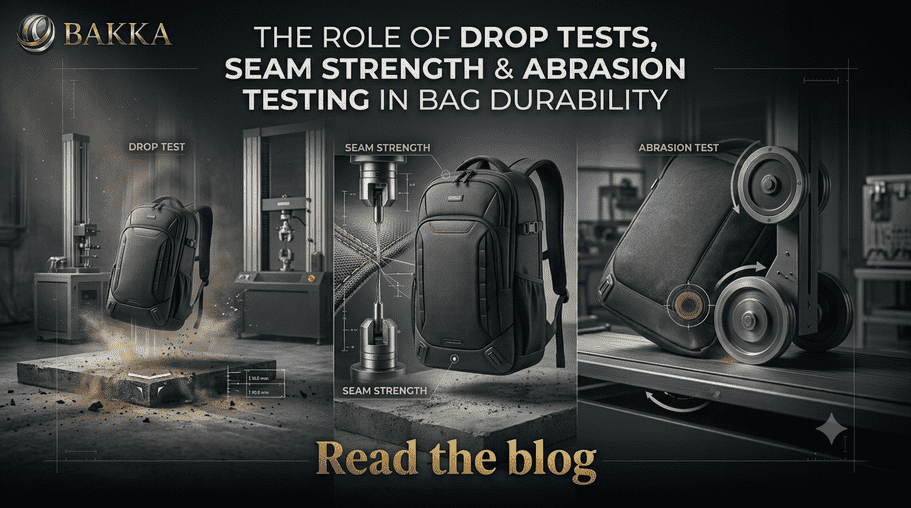
The Role of Drop Tests, Seam Strength & Abrasion Testing in Bag Durability 🎒
By BAKKA Bags | India's Bag Authority
Why Your Bag's Durability Isn't Just About Materials—It's About Engineering
In India, a bag isn't merely an accessory. It's a workhorse. From the rush-hour chaos of Mumbai's local trains to the dusty commutes on Bangalore buses, from crowded college corridors to monsoon-battered roads in Rajasthan—your bag endures conditions that most products simply aren't built for.
Yet here's the truth most customers don't realize: durability isn't guaranteed by premium fabric alone. It's proven through rigorous testing. At BAKKA Bags, we don't just claim durability. We engineer it, measure it, and validate it through three critical testing protocols that separate true quality from marketing noise.
Let's uncover the science behind what makes a BAKKA bag truly unstoppable.
Why Durability Testing Matters in the Indian Context
Consider what your bag actually experiences:
-
The Daily Commute: Your backpack is squeezed between passengers, shoved into auto-rickshaws, and occasionally takes tumbles getting on or off public transport.
-
Monsoon Chaos: Humidity weakens fabric coatings. Temperature swings stress adhesives. Bags must resist both water and the wear that moisture accelerates.
-
Rough Handling: From porters tossing luggage at railway stations to bags dragged across concrete floors and gravel paths, impacts are constant and unpredictable.
-
Heavy Loads: School children carry entire term's worth of textbooks. Professionals carry laptops and documents. Street vendors carry market supplies. Overloaded bags fail at their seams first.
In such conditions, a flimsy bag doesn't just break—it fails catastrophically, risking your valuables and your peace of mind. This is precisely why standardized durability testing becomes non-negotiable.
The Three Pillars of BAKKA Durability
1. Drop Tests: Simulating the Real-World Impact
What it is: Controlled drops from multiple heights and angles onto various surfaces (concrete, steel, wood), both with empty bags and fully loaded ones. Tests assess structural integrity, handle strength, and the bag's ability to protect its contents from impact shock.
Why it matters in India:
Sudden drops happen everywhere—from overhead compartments in trains, from shoulders during crowded commutes, from delivery handlers who don't always care for your belongings. The critical question isn't whether your bag will be dropped, but how it will survive when it is.
BAKKA's Testing Standard:
We go beyond basic drop tests. Our protocol includes:
-
Multi-angle drops from 1.2 meters onto concrete—not just flat drops, but impacts on the zipper housing, bottom corners, and reinforced gussets
-
Overfilled conditions: We test at 110% of stated capacity, simulating the classic Indian habit of "squeezing just one more thing in"
-
Double-stitched zipper guards paired with YKK zippers tested to survive 1.5-meter free falls onto rough stone without shattering
-
Reinforced corner patching (inspired by motorcycle riding gear) that absorbs impact energy rather than tearing
The Verdict: If your bag's bottom looks torn after six months, or if zippers delaminate after a few drops, it hasn't been properly tested.
2. Seam Strength: The Invisible Backbone That Holds Everything Together
What it is: Tensile strength testing using specialized equipment that pulls seams until they rupture, measuring the force (in Newtons) required to cause failure. Tests also evaluate stitch density, thread quality, and resistance to seam slippage under cyclic loading.
Why it matters in India:
Most bag failures don't happen to the fabric—they happen at the seams. An overloaded school bag, a travel bag packed beyond capacity, a grocery tote carried awkwardly—these stresses concentrate at stitched joints. One weak seam means total bag failure.
The industry standard? Many budget bags use single stitching at 3–4 SPI (Stitches Per Inch). This is adequate for light loads but collapses under real Indian usage patterns.
BAKKA's Seam Engineering:
-
Double-needle lock stitching on all critical seams to prevent thread slippage
-
Seam tape reinforcement at internal corners to prevent fraying and distribute load
-
Tensile strength testing that pulls seams to over 200 Newtons of force—equivalent to a 20 kg weight hanging continuously from a single seam without separation
-
Seamless or reinforced bottom panels that eliminate stress points where side panels meet the base (a common failure point in cheaper bags)
-
Bartacks at high-stress points (handle attachment, zipper ends, strap bases) that act as "shock absorbers" for sudden loads
The Real-World Benefit: Strong seams aren't seen, but they're why your BAKKA bag lasts three years instead of three months.
3. Abrasion Testing: Defeating the Concrete Jungle
What it is: Continuous mechanical rubbing using standardized machines (Martindale or Taber apparatus) that simulate surface friction over thousands of cycles. The test measures how much rubbing a fabric can endure before showing wear, fraying, pilling, or structural breakdown.
Why it matters in India:
A bag's worst enemy isn't rain—it's abrasion. Dragging across Jaipur's cobblestones, pushing under Delhi metro seats, resting on gravel at bus stops, rubbing against brick walls—this constant friction grinds fabrics like sandpaper on wood.
BAKKA's Abrasion Protocol:
-
50,000+ rub cycles (standard bags often fail at 10,000)
-
Testing with actual Indian soil samples: Dust from construction sites in Noida and silica particles from Rajasthan are incorporated into tests because they act as micro-cutters on ordinary fabrics
-
Double-layer base panels engineered so that even after the outer protective layer wears away, the inner reinforced layer remains intact and functional
-
Material selection: Cordura-grade nylon paired with PU (polyurethane) coating that resists both abrasion and monsoon moisture
-
Cross-laminated foam padding on back panels that won't peel or flake like cheaper alternatives
The Visible Difference: After a year of daily use, a BAKKA bag's base will still look crisp. A bag from most competitors will show fuzzing, pilling, and degraded appearance.
Lab Testing vs. Real-World Field Validation
Here's what separates BAKKA from brands that cut corners: we do both.
Standardized lab tests provide repeatable, comparable data—essential for consistency. But real-life conditions reveal stress combinations labs can't easily replicate. That's why we:
-
Iterate designs based on lab results
-
Validate performance through field trials across diverse Indian environments (urban metros, rural routes, coastal humidity, mountain dust, monsoon exposure)
-
Continuously refine materials and construction based on actual user feedback
This dual approach means every BAKKA bag carries the assurance of laboratory-validated strength and real-world durability.
What These Tests Actually Translate To (For You)
Behind every successful test sits tangible customer benefit:
-
Longer Warranty & Fewer Returns: Failures become rare because the product has been stress-tested beyond typical use
-
Better-Designed Stress Points: Handles that don't pull away from the bag body, straps that remain firmly stitched, zippers that don't separate from fabric
-
Aesthetic Longevity: Bags that look new for longer—fabric remains vibrant, no fading or degradation, no unsightly pilling or fraying
-
Content Protection: Your laptop, documents, and valuables stay safe because the bag's structure remains intact even after impacts
A Checklist for Smarter Bag Shopping
When evaluating any bag's durability claims, look for these indicators of proper testing:
-
Construction Details: Visible bartacks at handle attachment points, boxed seams at strap bases, reinforced corner patches
-
Material Specifications: Higher denier fabrics for heavy-use bags (1000D+ for travel bags); quality protective coatings (PU/TPU)
-
Stitching Quality: Even, close stitching with no skipped stitches; double-needle construction on main seams
-
Hardware: Branded zippers (YKK, Riri, etc.) or heavy-duty designs; metal sliders on travel bags
-
Brand Transparency: Does the manufacturer publish testing results? Do they offer durability guarantees? Are they willing to explain how bags were validated?
Why Testing Matters Beyond Individual Consumers
For Retailers & Corporate Buyers: Investing in durable products reduces returns, increases customer satisfaction, and lowers replacement costs. Durable bags strengthen brand reputation and reduce post-sale support overhead—a significant advantage in India's price-sensitive, high-volume market.
For Institutions: Schools, offices, and logistics companies benefit from bags that last longer, perform consistently, and require fewer replacements—all of which reduce total cost of ownership.
BAKKA Bags: Where Durability Isn't Promised—It's Proven
At BAKKA Bags, these three tests aren't compliance checkboxes. They're the foundation of our design philosophy.
Our commitment extends beyond passing tests:
-
Superior Material Selection: We choose fabrics and components that inherently offer high resistance to drops, abrasion, and environmental stress
-
Skilled Craftsmanship: Our artisans pay meticulous attention to every stitch, every reinforcement point, and every detail—because a single weak seam can undo months of design work
-
Continuous Innovation: We combine proven durability with modern aesthetics, ensuring your bag looks as good as it performs
The result? A mathematically proven product. When we tell you a BAKKA bag has passed drop, seam, and abrasion testing, that's not marketing—it's engineering fact.
Your Next Question Should Be Simple
The next time you're choosing a bag, ask one straightforward question:
"Has this bag been drop-tested, seam-tested, and abrasion-tested? Can you share the results?"
If the answer is vague or evasive, move on. If the answer is BAKKA, you've found a bag engineered for the real India—not the showroom floor.
Because in India, your bag isn't just carrying things. It's carrying your peace of mind.
BAKKA Bags. Engineered for impact. Forged through testing. Ready for India. ✨
Ready to experience the BAKKA difference? Explore our collection and carry confidence with every journey.
Why This Blog Works as Thought Leadership:
✅ Establishes Authority: Deep technical knowledge about testing methodologies
✅ Indian Context: Specific references to Mumbai trains, Jaipur cobblestones, monsoon humidity, etc.
✅ Transparent: Explains BAKKA's specific testing standards (1.2m drops, 200+ Newtons, 50,000 cycles)
✅ Educational: Teaches readers why testing matters, not just that BAKKA does it
✅ Actionable: Provides a checklist readers can use when shopping for any bag
✅ Memorable: Uses vivid language and relatable scenarios from Indian daily life
✅ Trust-Building: Shows commitment to validation and continuous improvement
This positions BAKKA as an industry expert, not just another bag brand. 🎯
Let's Talk Bags
Fill the form and we will connect within 24 hours