Understanding Fabric Deniers, GSM & Thread Count for Bag Durability | BAKKA Bags
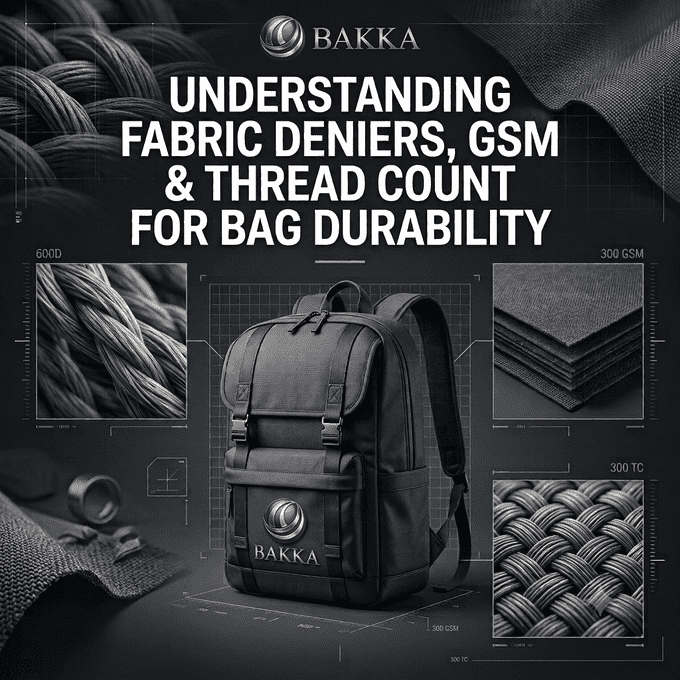
Understanding Fabric Deniers, GSM & Thread Count for Bag Durability
By BAKKA Bags | The Bag Authority
You've probably seen numbers like 600D, 300 GSM, or Thread Count 400 on a bag's product description and thought — what does any of this actually mean for me?
Here's the truth: these numbers are the difference between a bag that falls apart in six months and one that becomes your most trusted companion for a decade.
At BAKKA Bags, we don't just put fabric on frames and call it a bag. Every spec we choose — denier, GSM, thread type, stitching density — is a deliberate decision rooted in real-world performance. So today, we're pulling back the curtain and giving you the complete insider's guide to bag fabric science. Because when you know what makes a bag truly durable, you'll never settle for less again.
🔬 The Three Pillars of Bag Durability
Bag durability isn't defined by a single number. It's a system — and every component matters. The three core metrics are:
-
Denier (D) — The strength of individual fibers
-
GSM (Grams per Square Meter) — The overall density of the fabric
-
Thread Count (TC) — The tightness of the weave
Understand all three together, and you'll understand exactly what your bag is made of — and how long it will last.
1️⃣ Denier — The Backbone of Bag Strength
What Is It?
Denier is the unit of measurement for the linear mass density of a single fiber. In plain English: it tells you how thick and heavy each individual yarn is in the fabric.
The definition is beautifully simple: 1 denier = the weight in grams of 9,000 meters of a single fiber thread. A higher denier number means a thicker, heavier yarn — and typically, a tougher fabric.
What It Means for Your Bag
Think of denier like the gauge of steel wire. Thicker wire handles more load. Similarly, higher-denier fabric resists tearing, abrasion, and punctures far better than lower-denier alternatives.
Here's how denier typically maps to bag applications:
|
Denier Range |
Typical Use Case |
Durability Level |
|
70D – 150D |
Bag linings, packable rain covers |
Low to Medium |
|
210D – 420D |
Casual daypacks, gym bags |
Medium |
|
600D – 900D |
Everyday backpacks, travel duffels |
High |
|
1000D – 1680D |
Military gear, heavy-duty luggage, tactical bags |
Very High |
The BAKKA Insight 💡
Higher denier ≠ automatically better. A 1000D bag made with poor stitching and weak seams will fail before a well-constructed 600D bag. Denier tells you about fiber strength — not the entire bag. That's why at BAKKA, we pair our denier selection with construction-level craftsmanship at every seam and stress point.
Trade-off to know: Higher denier fabrics are heavier and stiffer. A 1680D ballistic nylon is near-indestructible, but it's also substantial in weight. The right denier depends entirely on what you need the bag to do.
2️⃣ GSM — The Density You Can Feel
What Is It?
GSM stands for Grams per Square Meter — it measures the weight of a fabric if you were to cut a perfect 1m × 1m square of it and weigh it. While denier focuses on individual yarn thickness, GSM captures the overall density of the finished fabric, including how tightly it is woven and any coatings applied.
What It Means for Your Bag
GSM is your best indicator of a fabric's "meatiness." A denser, heavier fabric packs more material into the same space — meaning better resistance to wear, tear, and environmental stress.
|
GSM Range |
Bag Application |
What to Expect |
|
Under 150 GSM |
Packable totes, lightweight inner pockets |
Light, breathable, limited abrasion resistance |
|
150–300 GSM |
Standard backpacks, laptop sleeves, casual bags |
Balanced weight and durability |
|
300–600 GSM |
Hiking packs, messenger bags, structured duffels |
Excellent strength and structure |
|
600+ GSM |
Heavy-duty tool bags, industrial gear, premium alternatives |
Maximum toughness and robustness |
The BAKKA Insight 💡
GSM and denier tell different stories. A fabric made from 210D yarn can actually feel heavier than a loosely-woven 600D fabric if it's woven tightly enough. This is why you must compare GSM within the same fabric type — nylon to nylon, canvas to canvas — for it to be meaningful.
Also critical: When bags are coated with PU (polyurethane) or PVC finishes for water resistance, those coatings add to the GSM. So a coated fabric at 400 GSM is significantly more weather-resistant and longer-lasting than an uncoated version at the same weight. At BAKKA, our coated fabrics are chosen with this in mind — durability doesn't stop at the fiber.
3️⃣ Thread Count — The Unsung Hero of Weave Integrity
What Is It?
Thread count (TC) refers to the total number of threads — warp (vertical) + weft (horizontal) — woven into one square inch of fabric. You've likely heard of thread count in bed sheets, but in bags, it plays a different — and equally important — role.
In bags, thread count reflects weave tightness, not softness.
What It Means for Your Bag
|
Thread Count |
Weave Quality |
Bag Impact |
|
Below 200 TC |
Loose weave |
Prone to snagging, limited abrasion resistance |
|
200–400 TC |
Balanced weave |
Good flexibility with decent durability |
|
400+ TC |
Tight, dense weave |
Excellent tear resistance, prevents dirt and moisture penetration |
The BAKKA Insight 💡
Thread count alone doesn't make a bag tough. A high TC with low denier means fine, thin yarns packed tightly — great for smoothness, but still vulnerable to punctures. The real power comes from combining a medium-high TC with strong denier fibers. A 300 TC fabric using 600D nylon yarn is a durability powerhouse. A 500 TC fabric using 70D yarn is just a pretty weave.
One more nuance: Extremely high thread counts can actually make a fabric stiff and less flexible — problematic for bag flaps, curved seams, or areas that need to flex under load. Balance is everything.
⚙️ How Denier, GSM & Thread Count Work Together
This is where most bag brands stop talking — and where BAKKA goes deeper.
No single metric tells the full story. A bag's true durability is the result of all three specs working in harmony, combined with construction quality:
-
Denier → Determines individual fiber strength (abrasion and tear resistance)
-
GSM → Determines overall fabric density (structural robustness and weight)
-
Thread Count → Determines weave tightness (dirt resistance, snag prevention)
-
Weave Type → Ripstop, twill, or plain weave changes how tears propagate
-
Coatings & Finish → PU, PVC, or DWR treatments add weather resistance
Here's how the combination plays out in real bags:
|
Fabric Spec |
Strength |
Flexibility |
Weight |
Best For |
|
210D / 150 GSM / 400 TC |
Medium |
Very High |
Light |
Packable, casual totes |
|
600D / 200 GSM / 300 TC |
High |
Medium |
Moderate |
Everyday backpacks |
|
600D / 300 GSM / 300 TC |
Very High |
Lower |
Heavy |
Rugged travel, outdoor bags |
|
1000D / 400+ GSM / 300 TC |
Maximum |
Low |
Very Heavy |
Military, tactical, industrial |
The sweet spot for most premium everyday bags? 600D ripstop nylon at 280–350 GSM with a 280–320 TC — tough, structured, and still comfortable to carry.
🧵 The Part Most Brands Don't Tell You: Thread & Stitching Quality
Even the most impressive fabric specs are meaningless if the stitching fails.
At BAKKA, we treat thread type, stitch density, and reinforcement as equally critical as fabric specs. Here's why:
-
Thread Material Matters: Bonded nylon or bonded polyester threads are the gold standard. They resist abrasion, don't absorb water like cotton threads, and maintain tensile strength over years of use.
-
Stitches Per Inch (SPI): The optimal SPI for heavy-use bags is typically 8–12 stitches per inch. Too few concentrates stress; too many perforates the fabric and weakens it.
-
Reinforcement at Stress Points: Bar tacks, box-and-cross stitching, and rivets at strap anchors, base corners, and zipper ends are where bag longevity is truly won or lost. This is where cheap bags fail first.
-
Seam Construction: Double-needle topstitching and taped seams (for waterproofing) dramatically extend a bag's functional life.
-
Hardware: Quality zippers (YKK is the industry benchmark), robust buckles, and sturdy D-rings complete the picture. A premium fabric with a failing zipper is still a failed bag.
🔑 BAKKA Rule of Thumb: A well-constructed medium-weight bag will consistently outlast a poorly stitched heavy-duty one. Construction craftsmanship is never a secondary concern.
🎒 BAKKA's Spec Guide by Bag Type
Use this as your go-to reference when choosing or evaluating any bag:
|
Bag Type |
Denier |
GSM |
Thread Count |
Notes |
|
Casual Daypack / Commuter |
400D–600D |
150–250 |
200–300 |
Lightweight, daily-use fabric |
|
Travel Backpack |
600D–900D |
250–350 |
250–320 |
Add PU coating for weather resistance |
|
Laptop Bag / Designer Tote |
210D–420D |
150–250 |
300+ |
Soft touch, decent structure |
|
Hiking / Outdoor Pack |
800D–1000D |
300–450 |
280–350 |
Ripstop weave highly recommended |
|
Tactical / Military / Industrial |
1000D–1680D |
400–600+ |
300–400 |
Ballistic nylon, bartack reinforcement |
🧠 The BAKKA Durability Formula
After years of designing, sourcing, and testing bags across every category, here's the formula we stand by:
$$\text{Bag Durability} = \text{Right Denier} + \text{Appropriate GSM} + \text{Optimal Thread Count} + \text{Quality Construction}$$
Remove any one element, and the equation breaks down. This is why BAKKA never competes on a single spec — we engineer the entire system.
✅ Your Pre-Purchase Checklist
Before you buy any bag — BAKKA or otherwise — here's what to look for:
-
Check the denier — Is it appropriate for your intended use?
-
Ask about GSM — Does the fabric density match the bag's purpose?
-
Inspect the weave — Look for ripstop grids or tight, even weave patterns
-
Feel the stitching — Double-needle, reinforced at straps, zippers, and base corners
-
Test the hardware — Smooth zipper action, solid buckle clicks, sturdy D-rings
-
Look for coatings — PU or DWR finish for weather-exposed bags
-
Read real reviews — Real-world use will always validate the specs
Final Word from BAKKA Bags
Understanding denier, GSM, and thread count transforms you from a passive shopper into an informed, empowered buyer — someone who looks past marketing buzzwords and makes decisions based on engineering reality.
At BAKKA Bags, every product we design is built with this knowledge baked in from the very first sketch. We obsess over specs so you don't have to second-guess your purchase. We choose 600D ripstop where others choose cheaper 420D. We spec bonded polyester thread where others cut corners. We bartack every strap anchor because that's where bags die — and where ours survive.
Because a great bag isn't just made. It's engineered.
Explore the BAKKA Bags collection — built to the specs that matter. Every number earns its place.
📌 Share this guide with anyone still buying bags based on looks alone. They'll thank you later.
Let's Talk Bags
Fill the form and we will connect within 24 hours